Editorial
What does America get? A case for seed capital in Africa
American grants to African startups have stopped. There is a case for American seed capital in their place, and it can be made in Washington's own terms.
By AR Abdi · 2026-11-23
For several years, American aid agencies were among the first backers of young African companies. Propel's records hold 51 rounds, nearly all grants, from USAID and the US African Development Foundation, to 49 startups. Together they were worth $41.6 million, and the typical USAID round was $500,000. For 38 of them, it is the first round we have on record. The last of those rounds is dated 2024.
The reasons are well known. USAID has been wound down. The African Development Foundation withdrew $51 million in grants to small firms and startups, most of them in Kenya and Nigeria, as TechCabal reported in April 2025. Washington's stated policy for the continent is now trade and investment in place of aid.
A great deal has been written about what that change cost, and rightly. I would like to add a different question: what could come next, and what might be in it for both sides?
The question Washington is asking
The new policy asks one thing of every dollar: what does America get? It is a fair question, and African founders and investors should answer it.
The State Department says the approach has produced more than 60 deals worth over $25 billion. They are large: minerals, energy, a rail corridor. Africa still takes about 1% of American exports. By the department's own projection, the continent will hold 2.5 billion consumers by 2050.
Between those two numbers sits the work of young companies. The firms that will carry payments, deliveries, clinics, power and farm credit to those consumers are being built now, and they are raising small rounds. In our records, every disclosed pre-seed and seed round since January 2025 adds up to $294.9 million across 118 rounds. That is about 1% of the value of the deals Washington has announced.
What the record shows
America's development lender, the DFC, already backs African startups. We have it on 22 rounds in 18 companies. Thirteen were debt. Sixteen were in Kenya. One was a seed round: $1.5 million for Keep It Cool in November 2024. The DFC arrives late, lends more often than it owns, and rarely leaves Kenya.
The aid agencies arrived early, but they gave the money away. Of the 49 startups they funded, five went on to raise equity, $70.3 million between them. America holds no share of any of it.
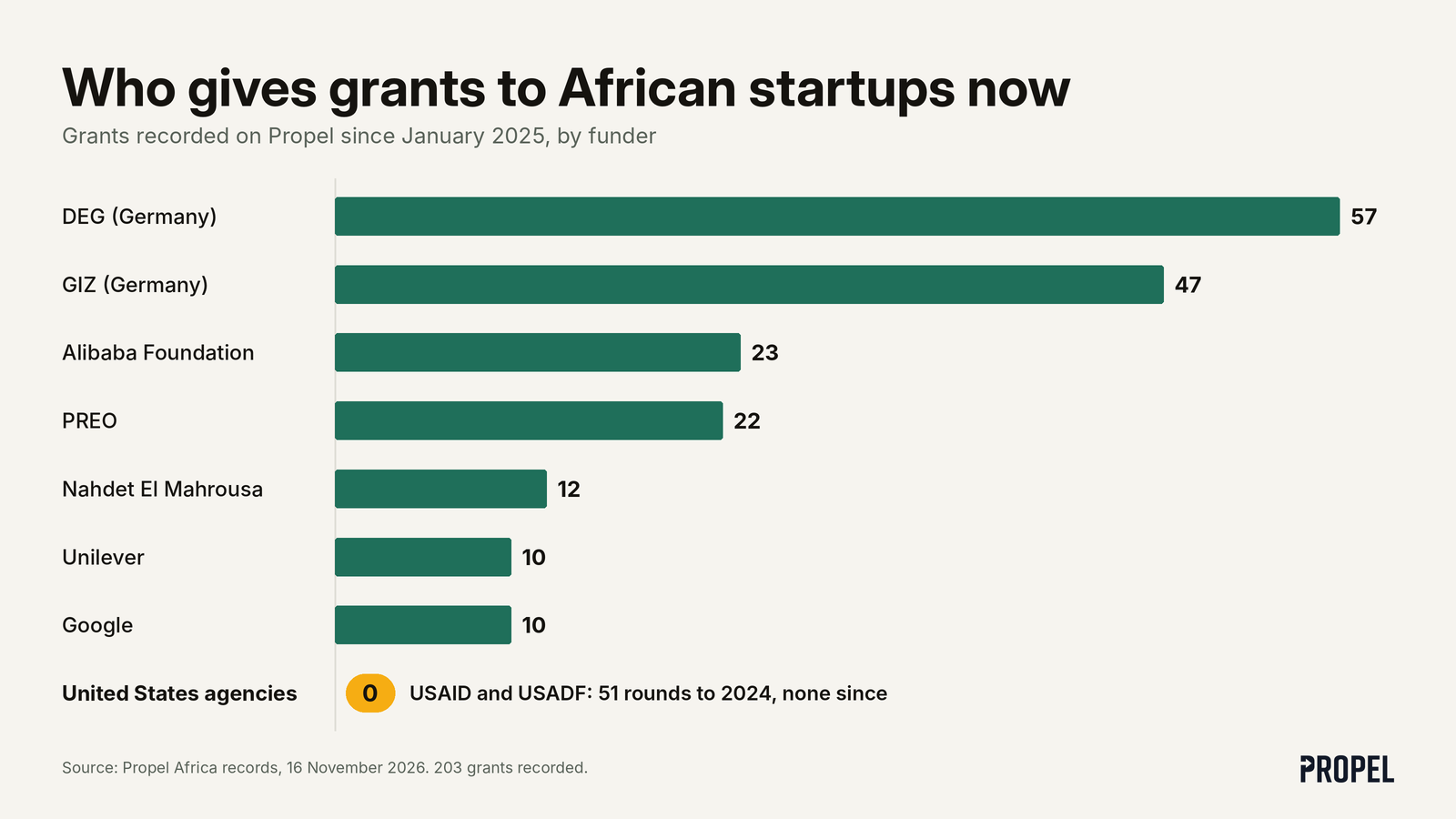
Others have stepped in. Since January 2025 we have recorded 203 grants to African startups. Germany's DEG is on 57 of them and GIZ on 47. The Alibaba Foundation is on 23. No American agency is on one.
The offer
So here is the offer, in return terms.
A seed cheque buys a stake, and a stake can pay back. A grant cannot. It costs little: the $51 million debt round the DFC joined for M-Kopa in 2024 is about a sixth of the whole seed market described above. It builds the lender's own future business, because the company raising $1 million today is the one asking the DFC for $50 million in 2032. And it puts American capital and American partners inside the companies that will decide which payment systems, cloud services and equipment those 2.5 billion consumers end up using.
The door is already opening. In October the DFC's regional managing director for Africa, Vibhuti Jain, told Reuters the agency will make more direct equity investments on the continent. Its largest so far, up to $155 million in the digital infrastructure company WIOCC, was announced in September. But the pipeline she described is critical minerals and large infrastructure.
The means exist too. Congress renewed the DFC for six years in December 2025 and widened its powers. The Atlantic Council has proposed a $3 billion revolving equity fund for it. What is missing is a window for the earliest stage: a modest pool, invested through African fund managers who already know these founders, in rounds below $2 million, in more than one country.
The honest objections
There are three, and each deserves a straight answer.
Venture capital cannot replace health or humanitarian aid, and nobody should pretend it can. The Center for Global Development has called a purely transactional approach an abdication, and on life-saving aid that is right.
Seed investing is slow and most bets fail. Returns will take a decade and will come from a few companies.
Governments are poor at picking startups. That is why the money should go through local managers with their own capital at risk.
None of this weakens the case. It defines it: a small, patient, commercially run window, alongside whatever else America chooses to do.
What we should do
For those of us building and backing companies here, the lesson is the same: do not wait. The founders who win the next cheque from any foreign funder, American, European, Gulf or Asian, will be the ones who can say plainly what the funder gets back.
The aid era taught us to describe need. This one rewards those who can describe a return.
Every figure here can be checked. Ask Propel who backed any company named above, or work through the deals yourself in The Propel Dataset.
Figures are from Propel Africa's records to 16 November 2026 unless a source is named. Round amounts are the totals disclosed for each round, not one investor's share. Sources: US Department of State, "America First in Africa" (March 2026); CSIS (December 2025); TechCabal (April 2025); Atlantic Council (September 2025); Center for Global Development (March 2026); Reuters (October 2026).