Feature
Borrowing to grow: how debt became a third of African startup money
Since 2024, debt has made up about a third of announced startup money in Propel Africa's records. Here is who is borrowing, who is lending and what it means for founders.
By AR Abdi · 2026-11-07
When people talk about African venture funding, they usually mean equity: a seed round, a Series A, a valuation. That is still most of the story. But going through Propel Africa's records, a second story kept surfacing. Debt, the money that has to be paid back, has grown from a footnote into roughly a third of announced startup funding. It rarely gets the headlines. It is changing who gets funded, and how.
A quick word on the data. Propel Africa's records track announced deals from January 2019 to August 2026. They are not a complete census: plenty of loans are never announced, and where an amount is our own estimate I have left it out of the money totals. I have also excluded acquisitions, listings and secondary sales. "Debt" here means loans, credit facilities and bonds.
From footnote to a third
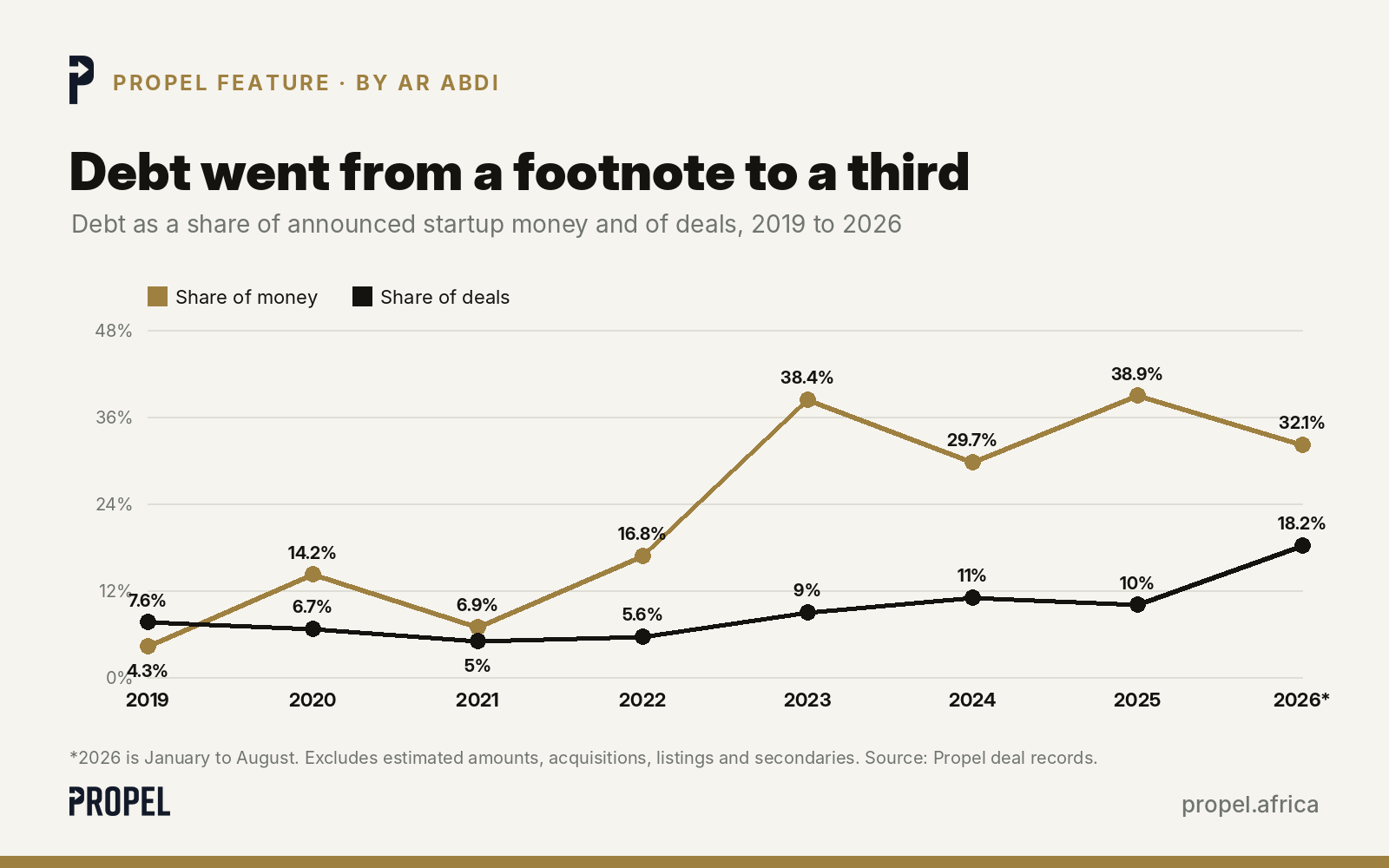
In 2019, debt made up 4.3% of the announced money in Propel Africa's records, or $57M out of $1.34bn. In 2021, the year equity went wild, it was still only 6.9%. Then the picture changed. Debt reached 38.4% of announced funding in 2023 and 38.9% in 2025, when it came to $1.16bn.
Taken together, January 2024 to August 2026 gives a clear split. Debt is 34% of the money but only 12% of the deals (180 of 1,490). Equity takes 64% of the money and grants about 1%. The median debt deal is $4M, against $1.5M for equity.
To be fair, part of that rise is equity shrinking: it fell from $3.9bn in 2021 to $1.5bn in 2024 in our records. But debt grew in its own right too, from $293M in 2021 to more than $1.1bn in both 2023 and 2025.
2026 adds a twist. In the first eight months, debt's share of money is 32%, below 2025's 38.9%, because nothing has yet matched last year's giant solar facilities. Its share of deal count, though, is 18.2%, the highest in our records: 55 debt deals, against 42 in the same months of 2025. Some of that is small loans, but strip out every debt deal under $1M and the share is still about 13%, up from under 9% for 2025 as a whole. There were also 16 debt deals of $10M or more by August, compared with 12 a year earlier.
Lending against what customers owe
Most of the big debt in our records is lending secured on money customers already owe, not a bet on a startup's future. A pay-as-you-go solar company sells a system, collects small payments for months, and that stream of payments can be packaged and financed.
The two largest examples sit in Kenya. In July 2025, d.light expanded a receivables facility, funded by Mirova and arranged by African Frontier Capital, with capacity to purchase over $300M of receivables. That is a ceiling, not cash drawn on day one, but it is our largest debt deal of 2025. The same month, Sun King closed a $156M securitisation in Kenyan shillings, backed by KCB, Co-operative Bank of Kenya and Absa Bank Kenya alongside British International Investment, Norfund and FMO. One industry report described it as the first instrument of its kind to be majority-funded by local commercial banks.
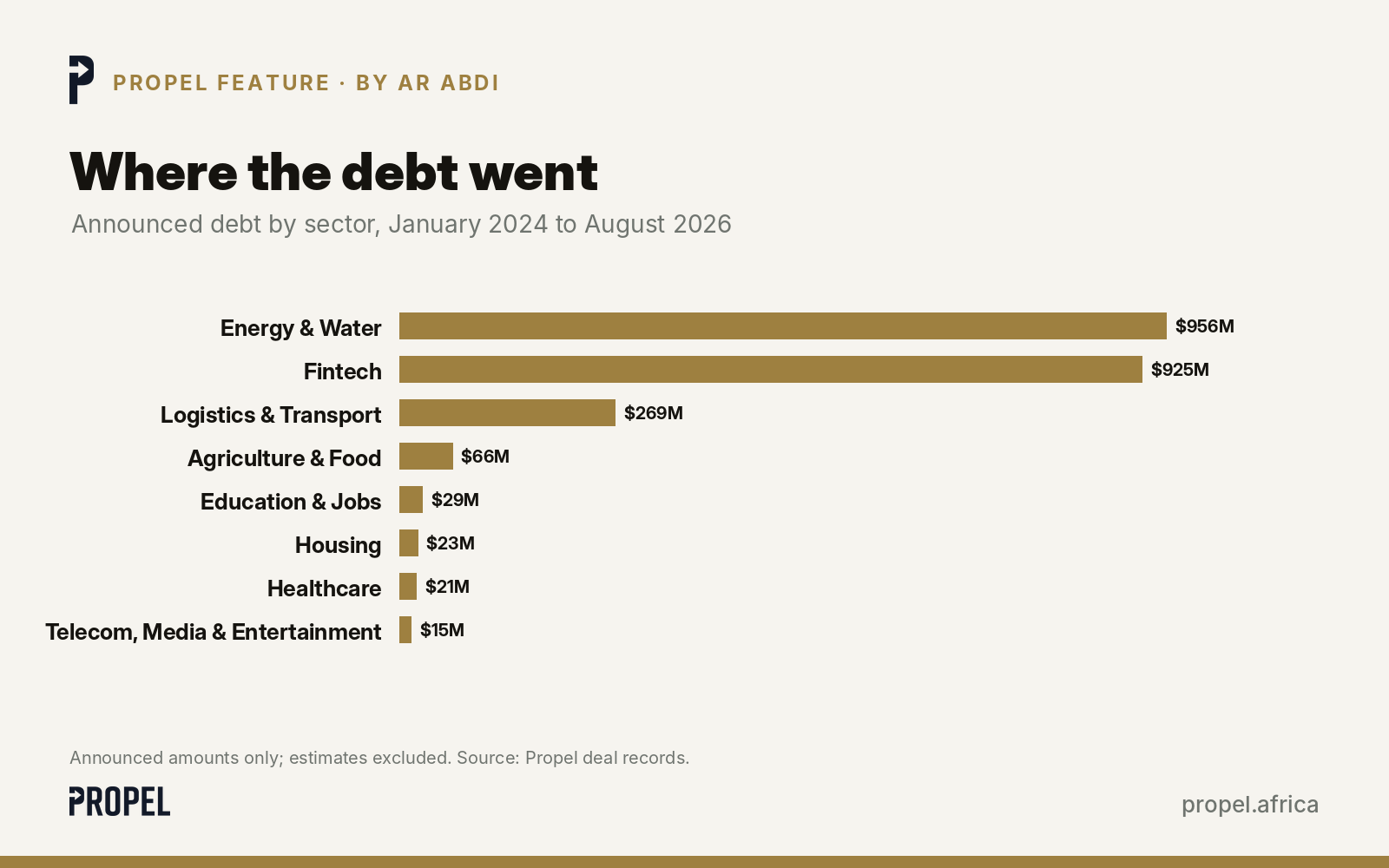
Those two companies alone account for $731M, or 31% of all announced debt in our records since January 2024. In the Energy & Water sector, 72% of announced money since 2024 has been debt.
The model is spreading beyond solar home systems. In May 2026, Apollo Agriculture pooled loans to 23,839 Kenyan smallholder farmers into a KES 276M (about $2.1M) securitisation, rated BBB- by Agusto. In September 2026, just after our records close, SunCulture announced a $10M securitisation of solar irrigation receivables, with Mirova's Gigaton Fund providing senior secured financing. In Egypt, lenders do the same with consumer loan books: MNT-Halan raised EGP 2.214bn (about $41.3M) in securitisation bonds in early 2026, and ValU appears eight times in our debt records since 2024, for $194.8M.
The currency question
Borrowing in dollars when customers pay in shillings, naira or rand hurts when the local currency falls. More recent deals are written in local money.
In November 2024, IFC backed Sun King in Nigeria with up to $80M equivalent in local currency, structured as a senior loan of up to seven years and split between IFC's own account, a blended concessional loan and a local commercial bank. A year later, IFC lent Lula R170M (about $10M) in rand, with at least 80% earmarked for micro and small businesses in South Africa. In July 2026, FMO was reported to be finalising $30M of senior debt in local currency for M-KOPA Kenya Mobility, the group's electric motorbike financing spinout, to fund pay-as-you-go receivables. And the largest debt deal in our 2026 records is ValU's short-term facility of up to EGP 3bn ($63.6M) from National Bank of Egypt in January.
Lenders are also adding protection: SunCulture's deal includes foreign exchange cover because its farmers pay in Kenyan shillings.
Who lends, and where it lands
The lenders fall into three groups. Development finance institutions are the backbone: British International Investment appears in nine debt deals since 2024, the U.S. International Development Finance Corporation in seven, and FMO in four. Local and regional banks are the second group, led by Standard Bank (five deals, including Standard Bank Group) and National Bank of Egypt (three). The third is a long tail of small-ticket lenders. Lendahand is the most frequent name in our debt records, with ten deals, followed by Untapped Global with eight and Bettervest with six, typically between $100,000 and $900,000 each.
Geography is lopsided. Kenya has 52 debt deals worth $1.12bn, 47% of all announced debt since 2024, and $851M of that is energy. Egypt follows with $498M, 72% of it raised by ValU and MNT-Halan. Nigeria has 34 debt deals but only $132M, mostly small loans.
This year the mix is shifting. Fintech accounts for 52% of debt value so far in 2026 and logistics and transport for another 24%, while energy has taken just $28.6M. Spiro raised a $50M facility from Afreximbank, Nithio and the Africa Go Green Fund in February to expand into Cameroon, Morocco and Tanzania. Nala secured up to $50M from Liquidity through Mars Growth Capital in May, starting with a $25M tranche, to pre-fund customer accounts. GoCab, which started in Abidjan, said in February it had raised $30M of debt alongside $15M of equity, money its chief executive said would let it deploy thousands of vehicles.
What this means for founders
My read is simple: debt is now a normal part of the African startup capital stack, not an exotic extra. But it is not equity with a different label, and the headline numbers flatter how available it is. Since 2024, almost half of announced debt has gone to just ten deals, mostly to businesses with something a lender can see and count: a loan book, a fleet of motorbikes, thousands of customers paying every month.
If your business looks like that, debt can let you grow without giving away more of your company, and the lenders are there: DFIs, local banks and specialist funds. Start early on three things. Keep clean, granular data on repayments and defaults, because that is what lenders price. Think about currency before you sign, not after a devaluation. And consider a small first facility from one of the platforms writing six-figure tickets to build a repayment record.
If you are pre-revenue, equity and grants are still your route, and that is fine. The lesson from the data is not that every founder should borrow. It is that once a business has steady cash flows, the funding conversation changes, and founders who plan for that moment will raise on better terms. At Propel Africa we will keep tracking debt as its own category.