
Feature
Who writes Africa's first cheques now? More often, a development funder with a grant
In 2025, 265 African startups had their first funding round recorded on Propel, under half the 2022 count, and 27% of those first rounds were grants, with Germany's DEG named on more of them than any other backer.
By AR Abdi · 2026-10-31
The Weekend Read, by AR Abdi
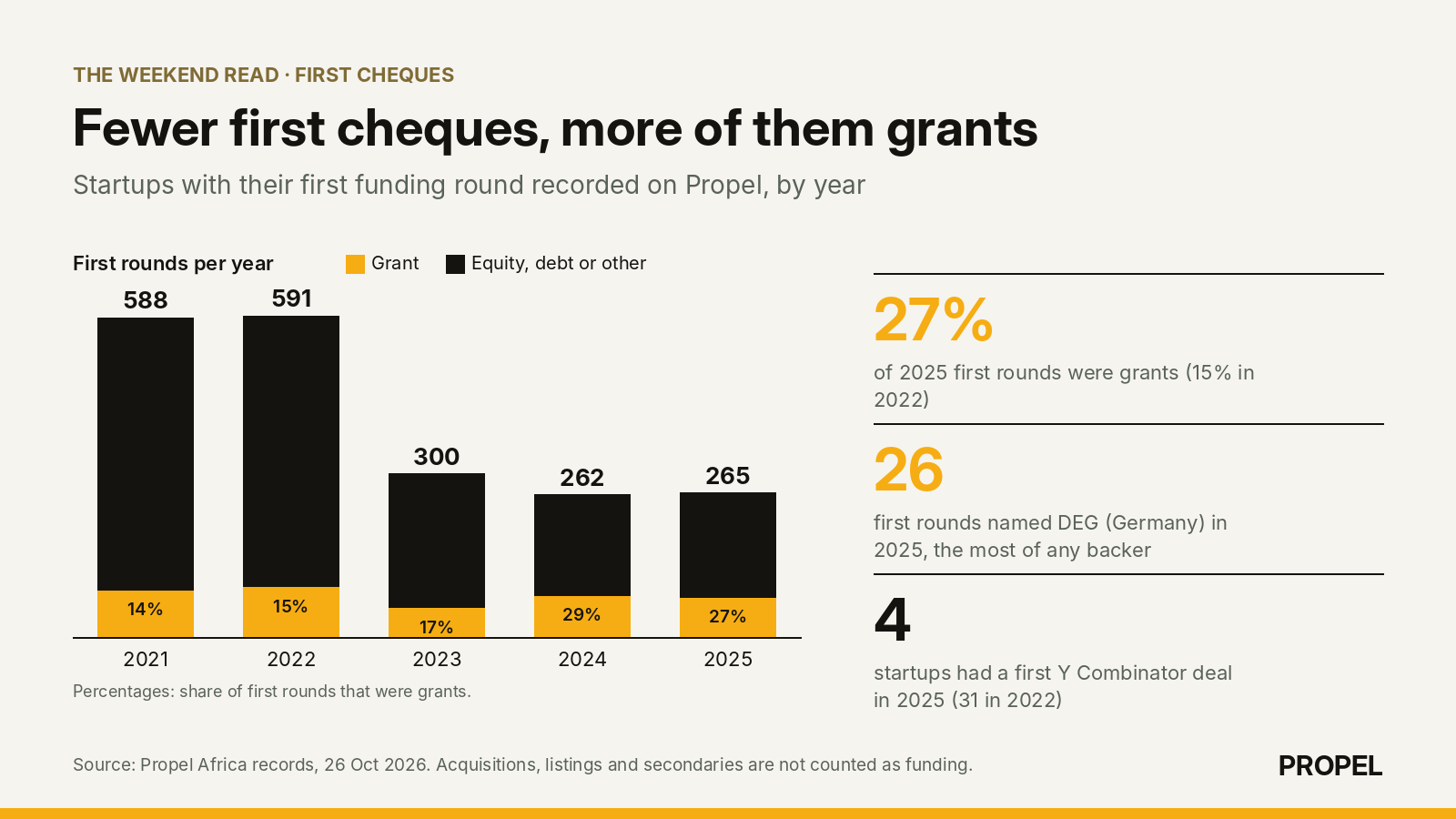
In 2022, 31 African startups had their first deal with Y Combinator recorded on Propel. In 2025 the figure was four. Techstars peaked a year later, at 54 in 2023, and fell to two in 2025. When we posted those numbers, the replies kept coming back to one question: who writes the first cheque now?
This piece answers that as far as our records allow. It looks at one moment in each company's life: its first funding round on record. That is not always the first money a company ever took, since early money often goes unannounced. It is the first round that reached the public record, and ours.
How we counted
For every startup on Propel, we took its earliest funding round on record. Acquisitions, listings and secondary sales are left out, because they are not funding. Grants and debt stay in, and are labelled as such. Where a company has more than one round on its first date, they count together as one first round.
Our records of small rounds are thinner before 2021, so the comparison starts there. The latest round in the records used here is dated 7 October 2026. This year is left out of the comparisons, because recent months keep filling in as announcements surface.
Half as many first rounds
588 startups had their first round recorded on Propel in 2021, and 591 in 2022. Then the count halved: 300 in 2023, 262 in 2024 and 265 in 2025.
That is the backdrop for everything below. Either fewer companies are reaching a first public round, or fewer of those rounds are being announced. Our records cannot tell those two apart.
A quarter of first cheques are now grants
What changed most is the kind of money. In 2022, a grant was the first round on record for 91 of 591 startups, or 15%. In 2024 it was 75 of 262, or 29%. In 2025 it was 72 of 265, or 27%.
The size of those grants barely moved. The middle grant on a first round was recorded at $100,000 in every year from 2021 to 2025.
Equity has not disappeared. In 2025, 67 startups made their first appearance with a round labelled pre-seed or seed, and 116 with a venture round that carried no stage label. But the share of first rounds that were grants nearly doubled in three years.
We have written before that grants are a quarter of African startup deals but about 1% of the money. At the very first round, the share is now about the same.
The names on the first round
In 2022, the backers named most often on first rounds were Flat6Labs (37 startups), Launch Africa (36), Future Africa (31), the Google for Startups Black Founders Fund (27) and Techstars (24): accelerators, seed funds and one grant programme.
In 2025 the list looks different. DEG (Germany) was named on 26 first rounds, more than any other backer. Next came Powering Renewable Energy Opportunities (PREO) with 13, the Alibaba Foundation and GIZ with 10 each, Digital Africa with 9 and Launch Africa with 7.
The top four are development or philanthropic funders, and what they put into first rounds was mostly grants.
DEG is a German development finance institution and a subsidiary of KfW. Of the 49 rounds naming DEG in 2025 on our records, 46 were grants, and 36 of those were recorded at $100,000. They went to startups in Kenya (23 rounds), Tanzania (14) and Rwanda (10), with one each in Ghana and South Africa. eFiche, a Rwandan health startup, is one of them: its only round on record is a $100,000 DEG grant from September 2025.
PREO, a renewable energy support programme for businesses that put off-grid power to productive use, appears on 13 first rounds in 2025, all grants recorded at $200,000 in July 2025. They run from Kenya and Uganda to Ethiopia, Malawi, Nigeria and Benin, where ZED Motors is one of the recipients.
The Alibaba Foundation, best known in Africa for the Africa's Business Heroes prize, is named on 10 first rounds, nine of them recorded at $100,000, from Morocco and Egypt to the DRC and Senegal.
GIZ, Germany's international cooperation agency, is named on 10 first rounds, all $100,000 grants recorded in December 2025, to startups in South Africa, Ghana and Nigeria.
We looked at the wider picture in Development funders, not VCs, back the most African startups. At the first round, the pattern is sharper still.
Who still writes the first equity cheque
On the equity side, a few backers come up again and again.
Digital Africa, part of the AFD Group, is named on 9 first rounds in 2025, most of them recorded at $100,000, into startups such as Muzikin in the DRC and Leya in Côte d'Ivoire. Launch Africa is on 7, with recorded cheques from $200,000 to $500,000, including Aspyre Foods in South Africa. Nubia Capital is on 6, each recorded at $100,000, including Syndicate Bio in Nigeria. Axian Group is on 5, including a $1 million seed round for Roadrims in Kenya in August 2025.
Y Combinator is still there, on 4 first rounds in 2025, and they are large ones. Cerebrium in South Africa made its first appearance on our records with an $8.5 million seed round alongside Gradient and Authentic Ventures.
Where the first money is based
Using the headquarters on each backer's Propel profile, the first grants have mostly come from outside the continent. Of the 72 first-round grants in 2025, one named a funder whose profile is based in Africa. In 2022 it was 12 of 91.
Equity first rounds lean the other way. In 2025, 97 of the 174 non-grant first rounds with a named backer we could match to a profile included at least one backer based in Africa, or 56%. In 2022 it was 299 of 463, or 65%.
Headquarters are a blunt tool. They show where a backer is registered, not where its people sit or where its money comes from, and some profiles are listed as Global.
A wider field, with fewer names
The number of different backers on first rounds fell with the number of rounds. In 2022, 556 different backers were named on a first round. In 2025 it was 233, and 175 of those were named on just one.
Beyond the few names above, the field is long and thin: three in four backers named on a 2025 first round appear on only one.
Grant first, equity next
Some companies are already moving from one to the other. Breaze Delivery in South Africa received a $100,000 GIZ grant in December 2025, then a $1.2 million round from Vumela Fund in June 2026.
It is one company, and we cannot yet say how common that path is. The 2025 group is too young for that question.
What the data cannot tell us
Our records hold announced rounds. Angel money, friends and family, and small cheques that are never announced mostly do not reach them; angel investors appear by name on only a few first rounds.
They cannot say whether fewer first rounds means fewer new startups or fewer announcements.
They cannot say whether starting with a grant helps a company raise its next round, or slows it down. That needs a few more years.
And they cannot say which backers did the most work. A $100,000 grant through a programme and a $100,000 equity cheque from a fund that stays for the next round both count as one first round here.
What they do show is a change in who is named first. In 2022 it was mostly accelerators and seed funds. In 2025 it was more often a development funder, with a grant of about $100,000.