
Feature
How many African startups get a second round? On Propel's data, fewer than four in ten
Of 629 African startups whose first round recorded on Propel was under $1 million in 2021 or 2022, 242 raised again by the end of 2025, 127 went on to a round of $1 million or more, and four reached $20 million.
By AR Abdi · 2026-11-06
The Weekend Read, by AR Abdi
At the end of October, Axel Peyriere, chief executive of AUTO24, posted a small funnel on LinkedIn. Using data from Africa: The Big Deal, he took 626 African startups whose first known raise was under $1 million in 2021 or 2022. Of those, 245 raised again, 132 later raised $1 million or more, 31 reached $5 million and 4 reached $20 million.
We ran the same cut on Propel's data and got almost the same shape. When two separate datasets land that close, the funnel deserves a closer look. So this piece takes the question further: how long a second round takes, where it happens most often, and who the four are.
How we counted
We took every African startup whose first round recorded on Propel came in 2021 or 2022 with a disclosed amount under $1 million. That gives 629 startups.
Grants are out throughout, because the question is about raising capital rather than winning an award. Acquisitions, listings and secondary sales are out, because they are not funding. Debt stays in. Rounds on the same date count as one.
A later round with no disclosed amount counts as raising again, but it cannot count towards a size line. Undisclosed is not zero. It is unknown.
We stopped the clock at 31 December 2025, because 2026 is still filling in as announcements surface. That is why these figures sit slightly below the ones we shared under Axel's post, which also counted 2026.
The funnel
Of the 629 startups:
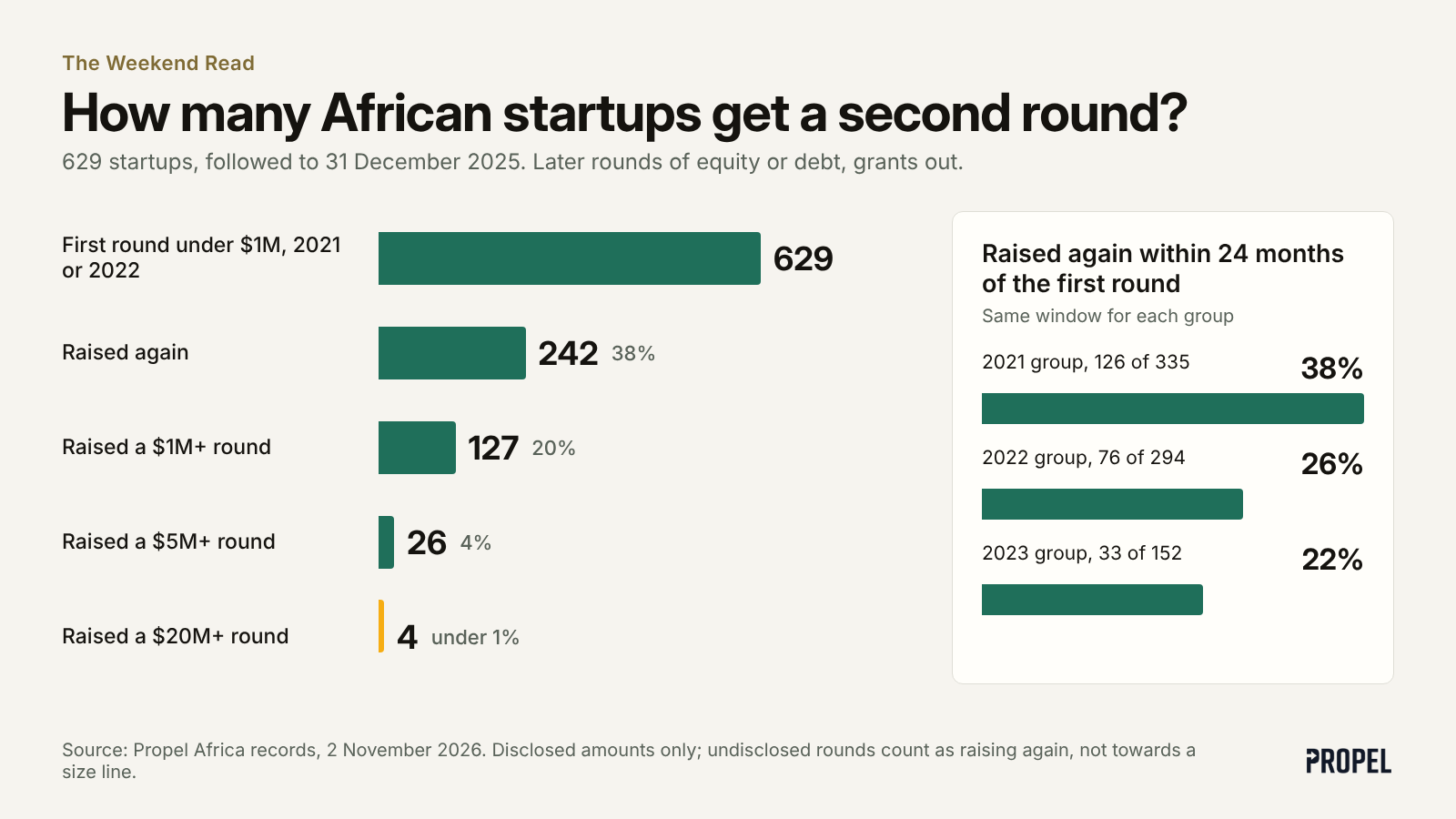
- 242 raised again by the end of 2025, or 38%.
- 127 went on to raise a single round of $1 million or more, or 20%.
- 26 raised a single round of $5 million or more, or 4%.
- 4 raised a single round of $20 million or more, under 1%.
The first step is the largest. 387 startups have no later equity or debt round on Propel.
Of the 242 that did raise again, 104 stayed under $1 million in every later round with a disclosed amount, and 11 raised only undisclosed rounds.
The step Axel called a wall comes next. Of the 127 startups that reached a $1 million round, 101 had not raised a $5 million round by the end of 2025. That is four in five.
The 26 include Djamo in Côte d'Ivoire, Chari in Morocco and Complete Farmer in Ghana.
The picture changes a little if you add a company's later rounds together instead of looking for one large round. On that count 130 startups reached $1 million, 35 reached $5 million and 9 reached $20 million.
Most second rounds come quickly
For the 242 startups that raised again, the middle gap between first and second round was about nine months. 145 of them, or 60%, did it within a year. 202, or 83%, did it within two years. Only 40 took longer.
Treat those gaps as approximate, since many rounds are dated to the month rather than the day. The direction is still clear: on Propel's data, a second round tends to come soon or not to be recorded at all.
Djamo shows how quick it can be. Its $130,000 pre-seed from Y Combinator is dated February 2021, and a $500,000 round with Norrsken and Partech Africa followed that April.
Reaching a $1 million round took longer: a middle gap of 12 months from the first round for the 127 that got there.
Backers often came back. In 78 of the 242 second rounds, or 32%, at least one backer from the first round appeared again.
The two-year window has narrowed
Older groups of startups have had more time, so a fair comparison gives each year's group the same window: did they raise again within 24 months of their first round?
- Of the 2021 group, 126 of 335 did, or 38%.
- Of the 2022 group, 76 of 294 did, or 26%.
- Of the 2023 group, 33 of 152 did, or 22%.
The 2023 group is also less than half the size of the 2021 group. Fewer startups reached a first round under $1 million with a disclosed amount, and a smaller share of them reached a second within two years.
Our data shows that change. It does not show the cause.
Where a second round is more common
Among countries with at least 20 startups in the group, the share that raised again ran from 54% in Ghana (13 of 24) to 50% in Kenya (44 of 88), 46% in Nigeria (78 of 170), 42% in Morocco (16 of 38), 31% in Egypt (37 of 118), 21% in South Africa (16 of 77) and 13% in Tunisia (5 of 38).
These are counts of announced rounds, so they also reflect how often later rounds are made public in each market. Ghana's share rests on 24 startups, and a few rounds either way would move it.
By sector, logistics and transport had the highest share of the larger groups, with 32 of 58 raising again, or 55%. Fintech followed with 76 of 167, or 46%, and supplied 40 of the 127 startups that reached a $1 million round. Agriculture and food had 22 of 59 (37%), healthcare 20 of 55 (36%) and retail 18 of 56 (32%).
The size of the first cheque made less difference than we expected. Startups that opened with $100,000 to $249,000 raised again 37% of the time (154 of 414). Those that opened with $500,000 to $999,000 did so 42% of the time (50 of 118).
The name on the first round showed a wider gap. Among backers named on at least 10 of these first rounds, Y Combinator had the highest share: 21 of its 27 startups raised again. Ventures Platform followed with 7 of 11, and Norrsken with 8 of 13. We cannot separate picking well from opening doors, and the records do not try.
The four that reached $20 million
Four startups in the group raised a single round of $20 million or more by the end of 2025.
Vendease, the Nigerian food procurement marketplace, was the fastest. It went from a $130,000 Y Combinator pre-seed in March 2021 to a $3.2 million seed that October and a $30 million Series A in September 2022, 18 months after its first round.
LemFi, the Nigerian fintech for Africans abroad, also began with Y Combinator, at $130,000 in July 2021. A $730,000 pre-seed followed that November, then a $33 million Series A in August 2023 and a $53 million Series B in January 2025.
Tagaddod, the Egyptian biodiesel maker, took a $200,000 seed from LoftyInc Capital Management and Kepple Africa Ventures in February 2021 and $1 million the next month. Its $26.3 million Series A came in October 2025, 56 months after that first round, with FMO among the backers.
Burn, the Kenyan cookstove maker, started in our group with $680,000 of debt from Bettervest in August 2021. Six further rounds came before an $80 million debt round in June 2025, with the World Bank Group and Trade and Development Bank named on it.
What do they share? Less than you might think. They work in food, finance, fuel and cooking. Each took at least one round in between, so none jumped straight from a small first round to $20 million. For Vendease, LemFi and Tagaddod, a first backer came back in the very next round.
There is one more thing to note. Propel's profiles give Burn a 2010 founding date and Tagaddod 2014, so a first round in 2021 was not the start of their story. All four come from the 2021 group. No startup from the 2022 group had reached that line by the end of 2025.
What the data cannot tell us
The biggest number here is the one we know least about. Those 387 startups have no later equity or debt round on Propel, and that can mean many things. Some closed. Some are profitable and never needed more money. Some raised quietly. Our data cannot tell those apart.
A few signs do show up. 23 of the 387 took a grant later, and 9 have an acquisition, listing or secondary sale on Propel. Neither is a failure, and neither shows up in a funnel like this one.
Other limits matter too. 67 startups whose first round had no disclosed amount sit outside the group altogether. A first round recorded on Propel is not always a company's first money. The later groups have had less time. And a share built on a few dozen startups can move with a handful of announcements.
So the funnel answers the question it was built to answer. About four in ten of these startups have a second round we can see. How many of the rest are still building is the number founders would most like to have, and it is the one we cannot count.
Source: Propel Africa records, export of 2 November 2026, rounds dated to 31 December 2025. Axel Peyriere's funnel: LinkedIn, October 2026, using Africa: The Big Deal data.