
Ask ten founders what "seed" means and you will hear ten answers. The labels on funding rounds are loose, and they drift over time. A seed round in Lagos or Nairobi today is a very different thing from a seed round in 2018.
This chapter of the Propel Guide sets out each stage, from pre-seed to Series C. For each one it covers what investors expect, who usually writes the cheques, and how much African startups actually raise. The figures come from Propel Africa's deal records: every round with an announced amount and a named stage between January 2024 and August 2026.
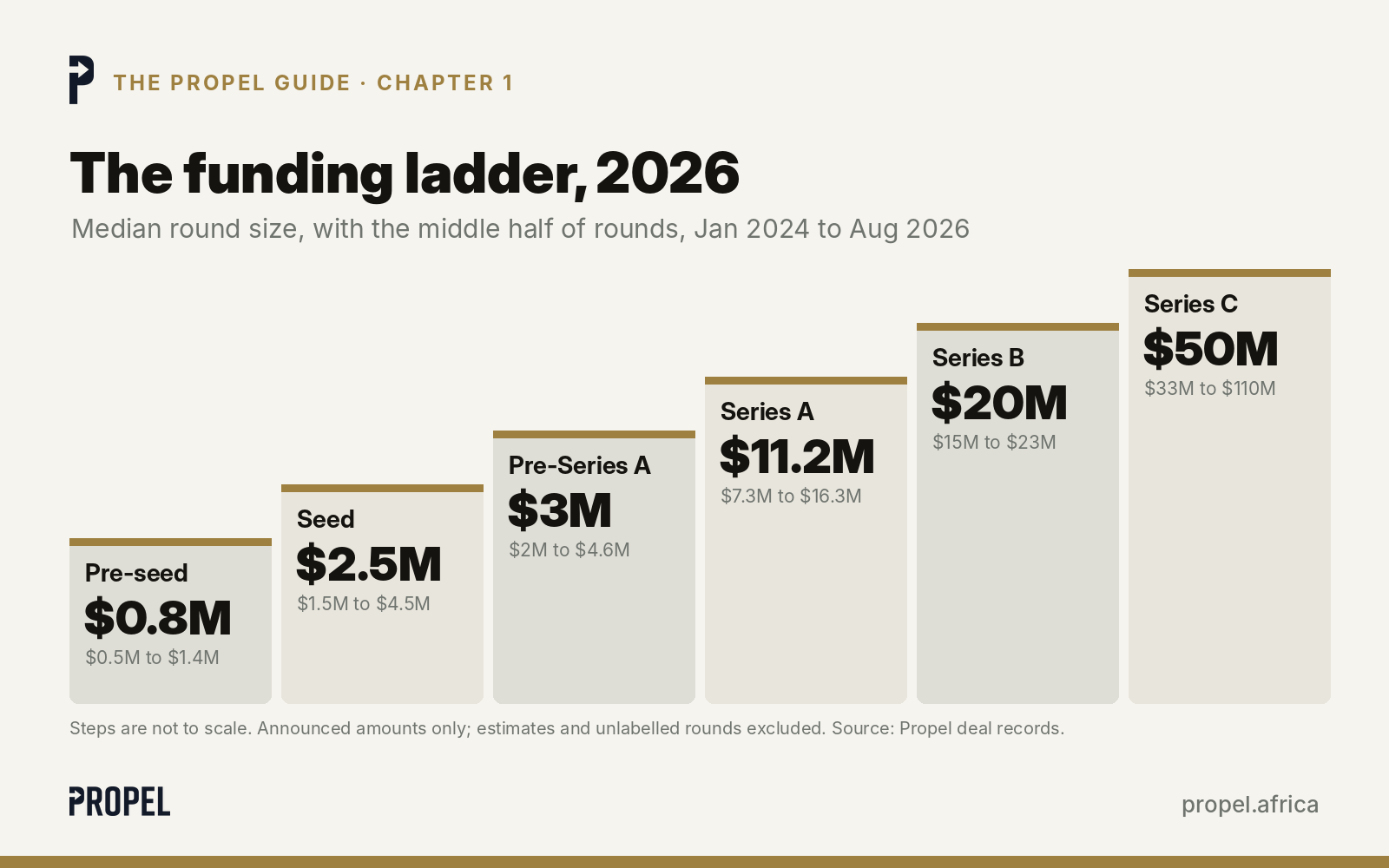
The ladder at a glance
| Stage | Typical round (median) | Middle half of rounds |
|---|---|---|
| Pre-seed | $800,000 | $500,000 to $1.4 million |
| Seed | $2.5 million | $1.5 million to $4.5 million |
| Pre-Series A | $3 million | $2 million to $4.6 million |
| Series A | $11.2 million | $7.3 million to $16.3 million |
| Series B | $20 million | $15 million to $23 million |
| Series C | $50 million | $33 million to $110 million |
The "middle half" is the range that covers the central 50% of rounds at each stage. A quarter of rounds were smaller and a quarter were larger. Series B and Series C are based on fewer deals, so treat those two rows as a guide, not a rule.
Pre-seed: proving the idea
Pre-seed is the first outside money. The company may have a prototype, a small group of users or nothing more than a strong team and a clear problem. Investors are mostly backing the founders.
The money usually comes from the founders themselves, friends and family, angel investors, grants and accelerators such as Y Combinator, Techstars and Antler. Many pre-seed rounds are raised on SAFEs or convertible notes rather than priced shares, which we cover in a later chapter.
The typical African pre-seed round is now about $800,000. This year, Verascient in South Africa raised a $1.2 million pre-seed led by Founder Collective, and Knot Technologies in Egypt raised $1 million led by A15.
Seed: finding product-market fit
At seed, a company has something in the market and is working out whether customers want it enough to pay, and keep paying. Investors want to see early traction: revenue, usage that grows on its own, or a few large customers who rely on the product.
Seed rounds are led by seed funds and angel networks. Firms such as Launch Africa, Microtraction, Madica and Ventures Platform are active at this stage.
This is where the market has moved most visibly. The typical seed round is now $2.5 million, and a quarter of seed rounds raise more than $4.5 million. In September, ChipMango in Nigeria raised a $1.9 million seed led by Atlantica Ventures. At the top end, GoCab in Côte d'Ivoire raised $15 million in seed equity in February, alongside $30 million in debt.
Pre-Series A: the bridge
Pre-Series A is a newer label. It is used by companies that have outgrown their seed money but are not yet ready for a full Series A, often because revenue is growing but not yet at the level Series A investors look for. In practice it often works as a top-up from existing investors, sometimes joined by one or two new ones.
The typical pre-Series A round is about $3 million. Tactful AI in Egypt raised a $1 million pre-Series A in February, co-led by Foras AI and M Empire Angels.
Series A: building the machine
Series A is about turning something that works into a business that can scale. Investors look for repeatable growth: a clear way to win customers, sound unit economics and a team that can hire and manage. Series A is usually the first priced round, where investors agree a valuation and buy shares.
Most Series A rounds in Africa are led by venture capital firms such as Partech Africa, TLcom Capital, Novastar Ventures, Enza Capital and Algebra Ventures. Development finance institutions sometimes join.
This is the stage that has changed most. The typical Series A is now $11.2 million, up from $3.3 million in 2018 and 2019. Recent examples include Synapse Analytics in Egypt, which raised $13 million led by Partech Africa, Yakeey in Morocco with $15 million, and Flextock in Egypt with $12.6 million led by TLcom Capital.
Series B and beyond: scaling up
From Series B, companies are raising to expand into new markets, add products or win a category. Investors look at revenue, margins and the path to profitability as much as growth.
These rounds bring in larger venture firms, growth funds, development finance institutions such as IFC, British International Investment, Proparco and FMO, corporates and sovereign funds such as Mubadala Investment Company.
The typical Series B is about $20 million and the typical Series C about $50 million, though the range is wide. NextProtein in Tunisia raised a $20.7 million Series B in November 2025, co-led by SWEN Capital and British International Investment. Mawingu in Kenya raised a $20 million Series C in October 2025, and Paymob in Egypt raised a $35 million Pre-Series C in September 2026.
How the ladder has changed
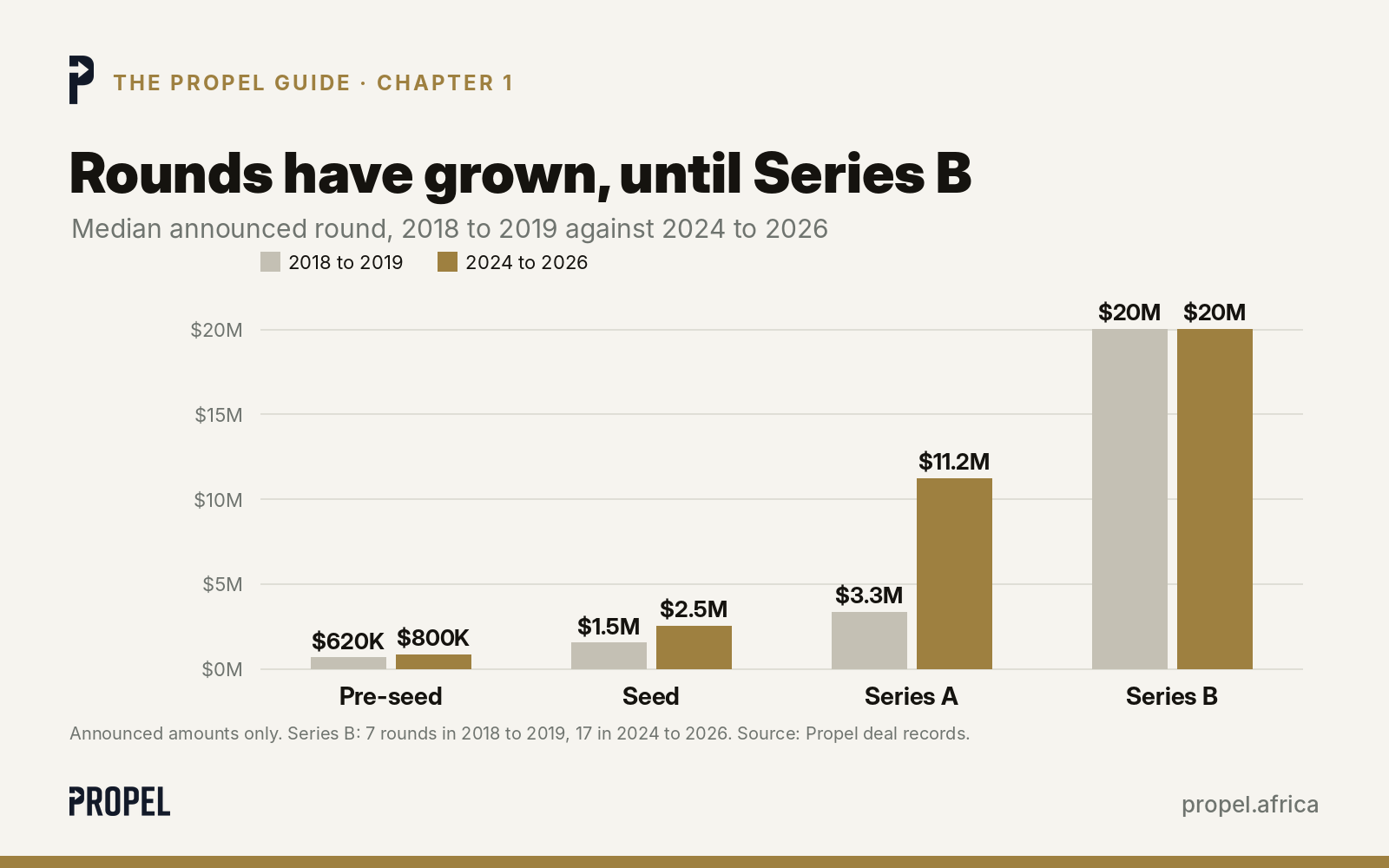
Compared with 2018 and 2019, the typical pre-seed round has grown from about $620,000 to $800,000 and the typical seed round from $1.5 million to $2.5 million. The typical Series A has more than tripled, from $3.3 million to $11.2 million.
Series B has not moved. The median was $20 million then and is $20 million now. More money is going into the early stages, and companies are expected to have achieved more by the time they raise a Series A.
Not every company climbs every rung
The ladder is a guide, not a rule. Many African startups skip a stage, raise an extension of the same stage, or never use the labels at all. In Propel Africa's records, more rounds are announced simply as "venture rounds" than as any single named stage.
Many companies also mix equity with other kinds of money. Grants help at the very start. Debt is common for companies with assets or steady revenue, such as solar, e-mobility and lending businesses, and it is a large part of the market: in Propel Africa's records, debt made up between 30% and 40% of announced startup funding in every year from 2023 to 2026. Founders call this non-dilutive capital, because it costs them no ownership. Spiro, for example, has raised large debt facilities alongside its equity. We cover grants, debt and mezzanine finance in chapter 2.
What this means if you are raising
- Use the ranges to sense-check your plan, not to set your target. Raise what you need to reach the next real milestone, plus a buffer.
- Expect to show more at each stage than founders did a few years ago, especially for Series A.
- Look at who has backed companies like yours. Every investor profile on Propel Africa lists the startups it has funded, and the round each one was.
How we measured
The figures cover rounds in Propel Africa's deal records from January 2024 to August 2026, and 2018 to 2019 for the comparison. They include only rounds with an announced amount and a named stage, as reported when the round was announced. Estimated amounts, unlabelled venture rounds, grants, debt and acquisitions are excluded. Medians use 85 pre-seed, 103 seed, 29 pre-Series A, 44 Series A, 17 Series B and 5 Series C rounds.
Next in the Propel Guide: grants, debt, equity and mezzanine, the four ways to fund a startup. New to a term in this chapter? See the glossary.