
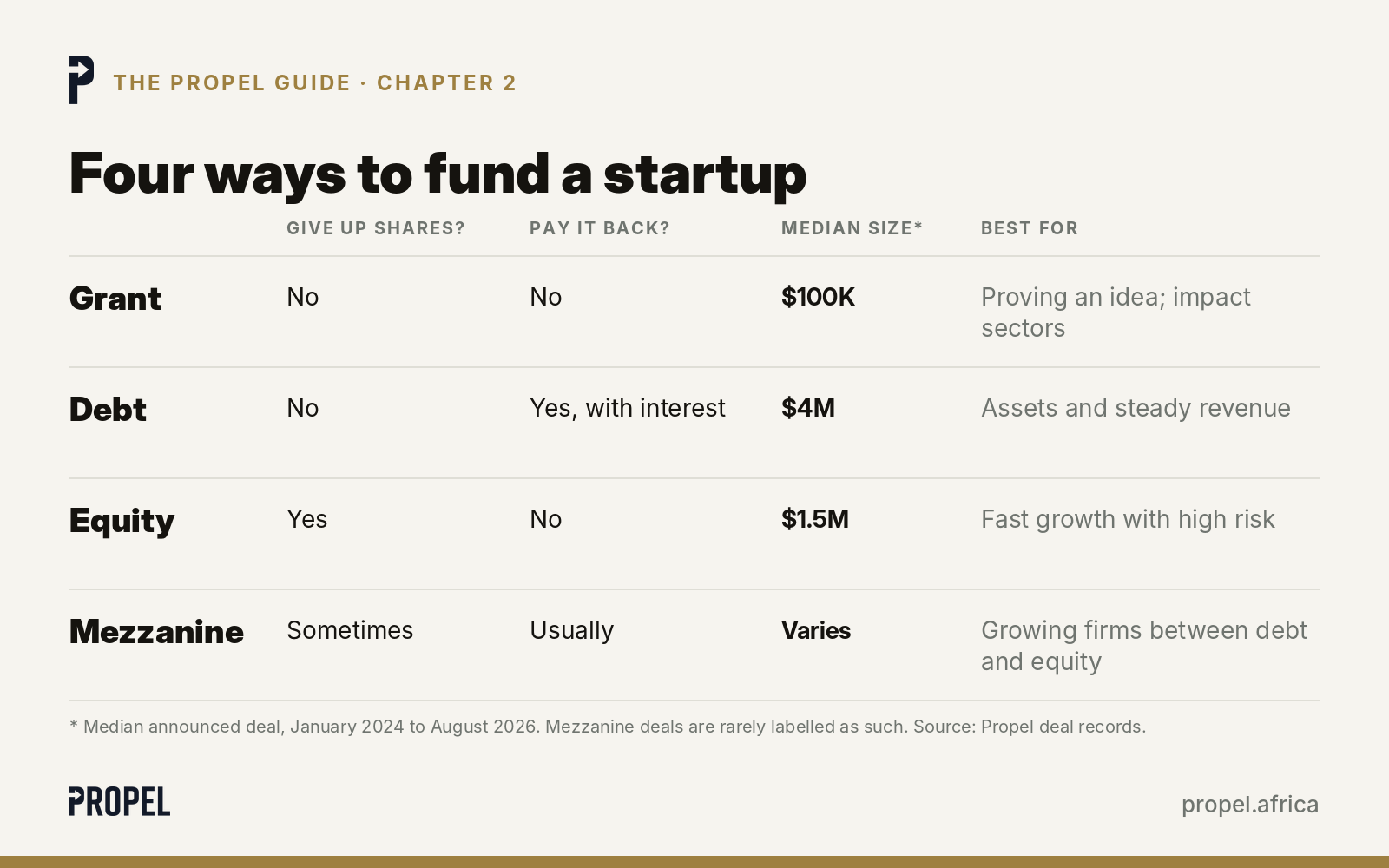
When people talk about funding, they usually mean equity: investors buying shares in a company. But equity is only one of four ways to pay for a startup, and in Africa the other three matter more than in most markets.
This chapter of the Propel Guide explains grants, debt, equity and mezzanine finance: how each works, what it costs you, and when it fits. The figures come from Propel Africa's deal records for January 2024 to August 2026.
What the market looks like
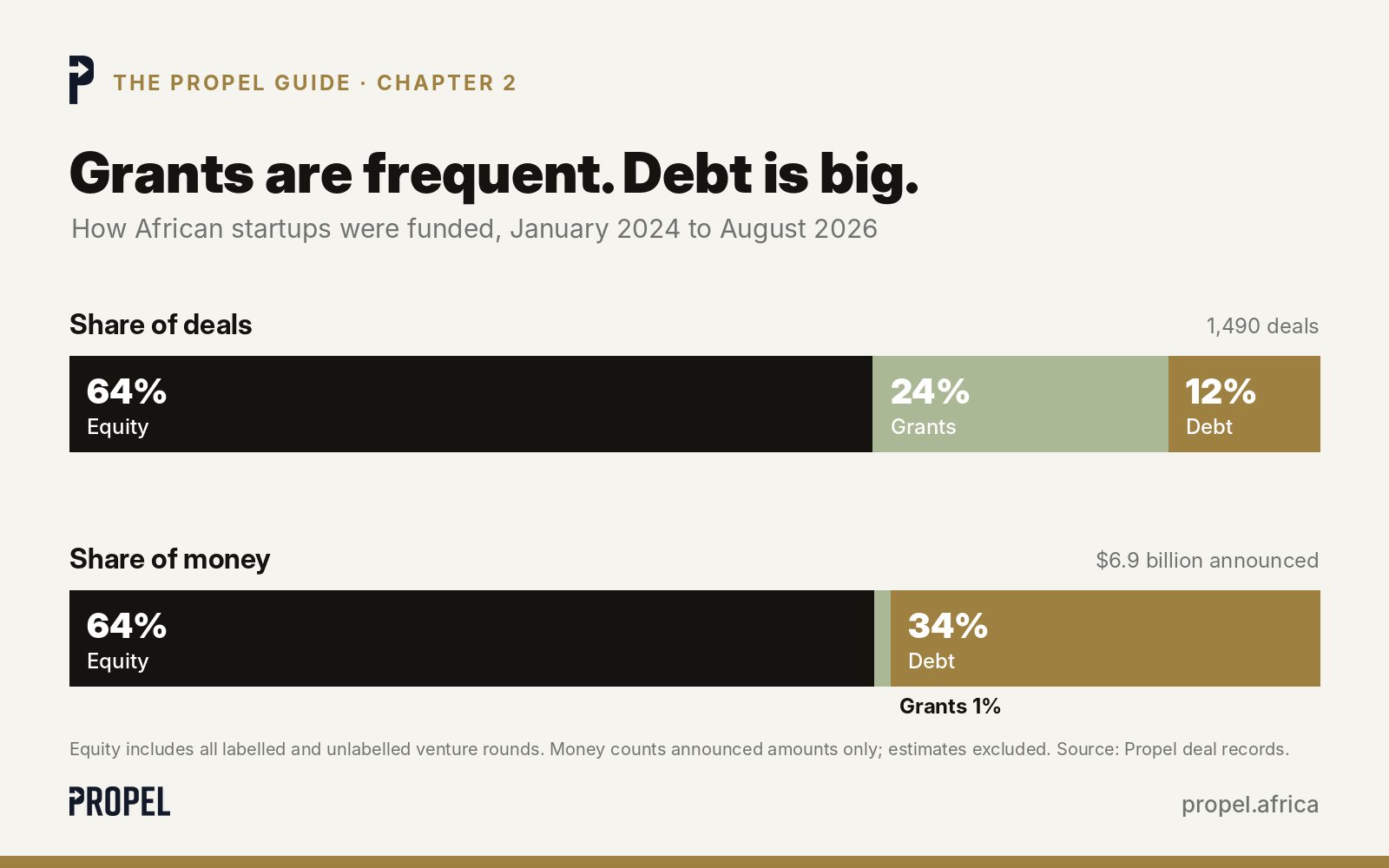
Across 1,490 deals in Propel Africa's records from January 2024 to August 2026, about 64% were equity rounds, 24% were grants and 12% were debt.
The money tells a different story. Of $6.9 billion in announced funding, equity made up 64% and debt 34%. Grants, a quarter of all deals, were about 1% of the money. Grants are frequent and small. Debt deals are fewer, but they are large.
Grants: free money, with strings
A grant is money you do not repay and that does not buy any shares. In Africa, grants come from development agencies, foundations, corporate programmes and competitions. Germany's DEG and GIZ are among the most frequent backers in Propel Africa's records, mostly through grant programmes.
What it costs you: no ownership, but time. Applications, reporting and conditions on how the money is spent can be heavy for a small team.
When it fits: proving an idea, early research and development, and impact sectors such as agriculture, health and education, which receive the most grants in Propel Africa's records alongside fintech.
How big: the median grant is about $100,000. Competitions can be larger. In September 2026 Waspito in Cameroon won the $250,000 Grand LEAP Award, and in February the GSMA Innovation Fund backed startups including Deepecho and ToumAI in Morocco.
Debt: borrow it, pay it back
Debt is a loan. You pay it back with interest, and the lender does not become an owner. That makes debt non-dilutive: founders keep their shares.
Lenders want to see that you can repay, so debt suits companies with assets or steady revenue. In Propel Africa's records, fintech, energy, logistics and agriculture companies take the most debt. Typical uses are financing motorbikes, solar systems, inventory or loans to customers.
Debt comes in many forms. Spiro, which runs electric motorbikes and battery swapping, secured a $50 million debt facility in February from Afreximbank, Nithio and Africa Go Green Fund. SunCulture, which sells solar irrigation in Kenya, closed a $10 million securitisation backed by Mirova in September, raising money against customer repayments. Drive45 in Nigeria took a $3 million senior debt facility from TLG Capital.
Currency matters too. A dollar loan is risky for a company that earns in naira, shillings or rand, so local-currency debt is growing. Lula in South Africa took a R170 million local-currency loan, about $10 million, from IFC in November 2025.
What it costs you: interest, and often security over assets or income. Missed repayments can be serious.
When it fits: predictable revenue, physical assets, or a lending book to fund. How big: the median debt deal is about $4 million.
Equity: sell part of the company
Equity investors buy shares. They take the risk that the company fails, in exchange for a share of the upside if it succeeds. There is nothing to repay.
What it costs you: ownership and some control. Each round dilutes the founders, and investors usually get rights such as a board seat or a say over major decisions.
When it fits: fast growth that cannot be funded from revenue or loans, especially for software, marketplaces and other companies without assets to borrow against.
How big: the median equity round across all stages is about $1.5 million. Chapter 1 sets out typical sizes stage by stage, from about $800,000 at pre-seed to $11 million at Series A. Recent examples include Paymob in Egypt, which raised a $35 million Pre-Series C in September, and ChipMango in Nigeria, with a $1.9 million seed.
Mezzanine: the middle layer
Mezzanine finance sits between debt and equity. It is usually a loan that ranks behind senior lenders and carries extra rewards for the risk, such as a higher interest rate or the right to convert into shares.
Convertible instruments, which start as debt and can turn into equity, are a common form. Complete Farmer in Ghana secured a $2.4 million convertible loan co-led by IFC in September. Julaya in Côte d'Ivoire raised 800 million CFA francs in convertible bonds in October 2025, and Izili secured $5 million in convertible bonds in January. PowerGen received a $5 million mezzanine investment from All On in September to grow its mini-grids in Nigeria.
What it costs you: more than senior debt, and possibly some dilution later. When it fits: growing companies that want to limit dilution but are too risky for a plain bank loan.
Most companies mix them
Few companies use just one kind of funding. A common path is a grant or angel money to start, equity to build the product and team, then debt to fund assets once the business works.
Some raise several kinds at once. GoCab, which finances vehicles for ride-hailing drivers in Côte d'Ivoire, raised $15 million in seed equity and $30 million in debt in February. Rana Energy in Nigeria combined $500,000 of equity with a $2.5 million local-currency debt facility in October 2025.
Choosing what fits
- No revenue yet: grants, angels and pre-seed equity.
- Revenue, but no assets: equity, possibly with revenue-based financing.
- Assets or a lending book: debt, often alongside some equity.
- Growing fast and wary of dilution: mezzanine or convertible instruments.
Every profile on Propel Africa shows the kind of funding behind each round, so you can see how companies like yours have been financed.
How we measured
The figures cover 1,490 deals in Propel Africa's records from January 2024 to August 2026, excluding acquisitions, listings and secondary sales. Equity includes all labelled and unlabelled venture rounds. Debt includes loans and bonds. Money counts only announced amounts; estimated amounts are excluded. Medians are based on 332 grants, 171 debt deals and 684 equity rounds with announced amounts.
Next in the Propel Guide: who's who, the investors behind African startups. New to a term? See the glossary.