
"Investor" covers a lot of ground. A Lagos angel writing a $25,000 cheque, a Silicon Valley accelerator, a German development agency and an Abu Dhabi sovereign fund all back African startups, and each wants something different.
This chapter of the Propel Guide sets out the main kinds of investor, what each one looks for, and who is most active. The activity figures come from Propel Africa's deal records for January 2024 to August 2026.
The most frequent backers are not who you might expect
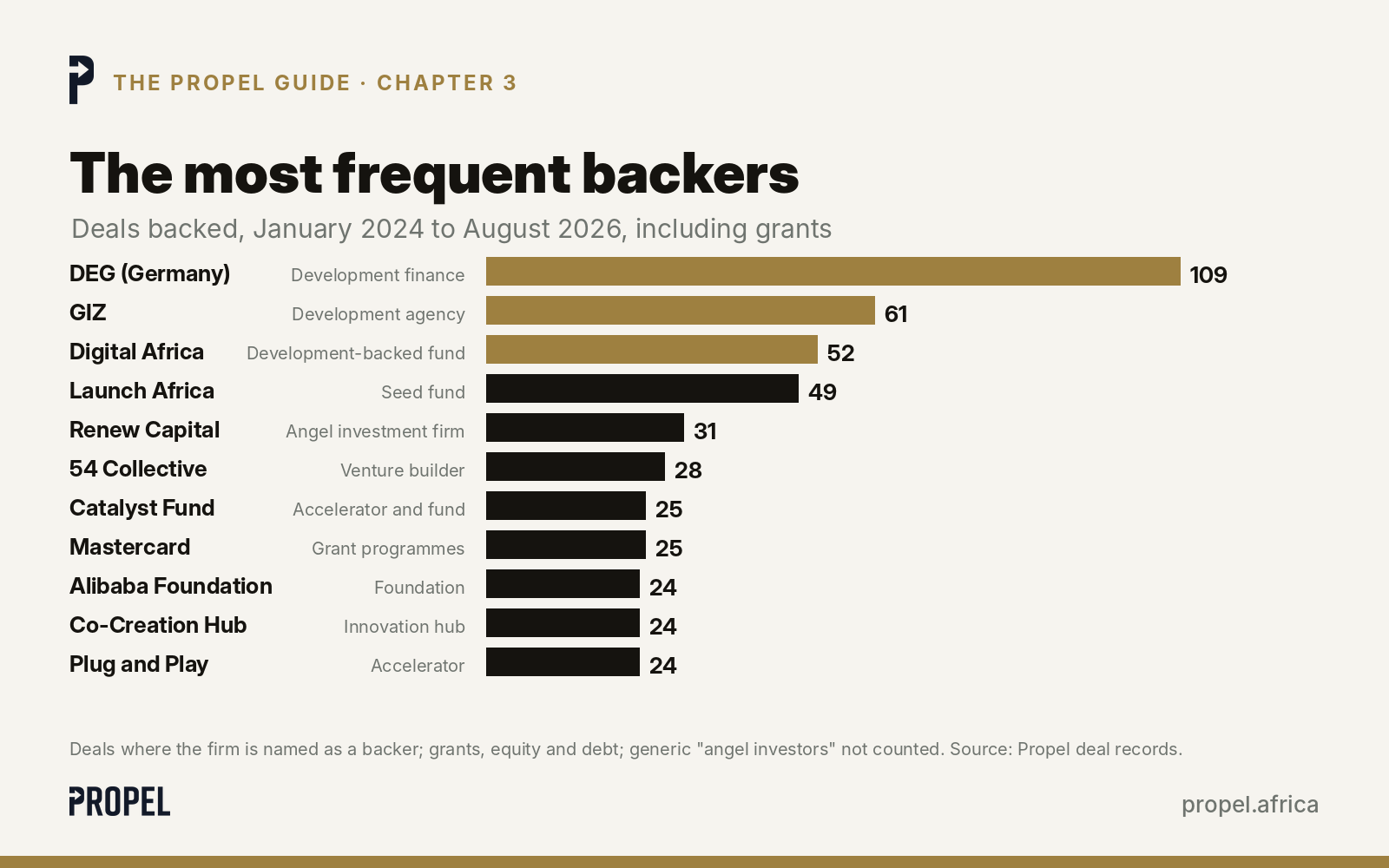
Count the deals and the names at the top are not venture capital firms. Development agencies, seed funds, angel networks and accelerators back the most companies, because they write many small cheques. Venture capital firms write fewer, larger ones.
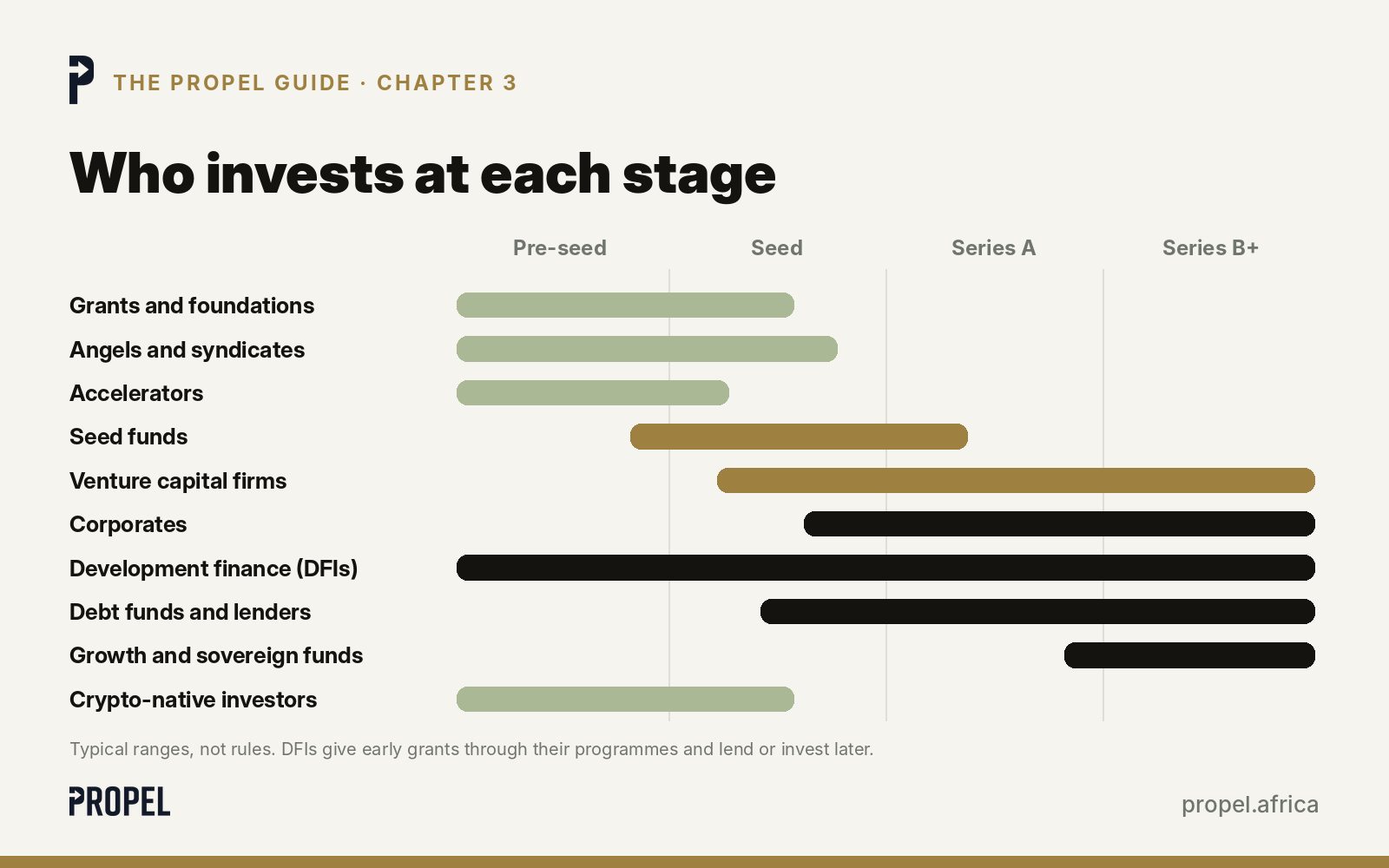
1. Development agencies, foundations and grant programmes
Public agencies, foundations and corporate programmes give grants and run competitions, usually to support jobs, health, climate or inclusion. Germany's development finance institution DEG, mostly through its grant programmes, backed more deals than any other named firm in Propel Africa's records, followed by the German development agency GIZ. Others include the GSMA Innovation Fund, the Alibaba Foundation and the Motsepe Foundation.
What they want: impact that fits their mission, and clear reporting. Cheque size: usually under $250,000.
2. Angels and angel networks
Angels are individuals investing their own money, often successful founders or executives. Many invest through networks or syndicates, which pool money and share the work of checking deals. Renew Capital, an angel investment firm, is one of the most active backers in Propel Africa's records, and groups such as the Cameroon Angels Network and Dakar Network Angels back companies in their regions.
What they want: a founder they believe in and a problem they understand. Angels often add useful introductions. Cheque size: from a few thousand dollars per angel to several hundred thousand for a syndicate.
3. Accelerators and innovation hubs
Accelerators run fixed programmes of mentoring and introductions, often with a small investment in exchange for equity. Some innovation hubs run grant programmes instead. Global names such as Y Combinator, Techstars, Plug and Play and Antler are active in Africa, alongside local players such as Catalyst Fund and Co-Creation Hub.
What they want: fast-moving teams early enough to benefit from the programme. Cheque size: usually $20,000 to $500,000.
4. Seed funds and venture builders
Seed funds specialise in the first institutional round. Some, called venture builders, also help start and staff companies. Launch Africa and 54 Collective are among the most active investors in Propel Africa's records, alongside others such as Madica, Microtraction, Ventures Platform and Chui Ventures.
What they want: early signs that customers want the product, and a market that can grow large. Cheque size: usually $100,000 to $2 million.
5. Venture capital firms
Venture capital firms raise money from institutions and invest it in startups for equity, aiming for a few very large outcomes. They usually lead Series A rounds and later. Active firms include Partech Africa, TLcom Capital, Novastar Ventures, Enza Capital, Norrsken22, Algebra Ventures, A15 and Janngo Capital.
What they want: a business that could become very large, a strong team and a clear way to grow. Cheque size: usually $1 million to $20 million, more in later rounds.
6. Corporates
Large companies invest directly or through venture arms, usually in startups close to their own business. Visa joined Moniepoint's $200 million round in October 2025, Orange Ventures co-led Chari's $12 million Series A, and credit bureau TransUnion co-led Omnisient's Series A.
What they want: a strategic fit, such as new customers, products or markets for the parent company. Cheque size: varies widely.
7. Development finance institutions (DFIs)
DFIs are government-backed investors that put money into private companies in emerging markets. The big names in Africa are IFC, British International Investment, Proparco, FMO and DEG. Digital Africa, backed by the French development agency AFD, is a frequent early-stage backer.
DFIs work across many stages. They run grant programmes for very young companies, and they invest equity, debt and mezzanine in larger ones. In Propel Africa's records, debt has made up a growing share of the big DFIs' deals since 2024.
What they want: commercial returns plus development impact, such as jobs, access to services or climate benefits, and strong reporting. Cheque size: from grants of a few thousand dollars to loans of tens of millions.
8. Debt funds and specialist lenders
A growing group of funds lends to African startups, often against assets or customer repayments. Examples include Symbiotics, TLG Capital, Mirova, Africa Go Green Fund and All On. Platforms such as Lendahand let many individuals lend to companies through crowdlending.
What they want: the ability to repay: steady revenue, good collateral or a strong loan book. Cheque size: usually $1 million and up.
9. Growth and sovereign funds
Growth funds, private equity firms and state-owned sovereign funds invest in later, larger rounds. Mubadala Investment Company of Abu Dhabi co-led Paymob's $35 million Pre-Series C, and Lightrock invested $40 million in Sun King in December 2025.
What they want: proven businesses with large revenue and a path to profit or listing. Cheque size: usually $20 million and up.
10. Crypto-native investors
A newer group invests capital from crypto markets, mostly in payments, stablecoin and blockchain startups. Hashed Emergent and StarkWare led Paycrest's pre-seed round in January together with Microtraction.
What they want: products that use blockchain rails, often for cross-border payments. Cheque size: usually early stage.
Finding the right investor
The best investor for you is one who already backs companies like yours, at your stage. Every investor profile on Propel Africa lists the startups it has funded and the round for each one, and the investor directory filters by the markets and sectors each firm invests in.
How we measured
The ranking of most frequent backers counts deals in Propel Africa's records from January 2024 to August 2026 in which a firm is named as a backer, including grants, equity and debt, and excluding acquisitions, listings and secondary sales. Generic entries such as "angel investors" are not counted as a firm. Cheque sizes are typical ranges, not limits. Each firm's description reflects its activity in our records and its own public description.
Next in the Propel Guide: SAFEs, convertible notes and priced rounds. New to a term? See the glossary.