
Feature
After the megaround: what happened next to Africa's $100 million startups?
Propel records 41 African funding rounds of $100 million or more since 2019, and of the 13 startups whose first came in the 2021 and 2022 boom, seven have no funding round on Propel since.
By AR Abdi · 2026-11-27
The Weekend Read, by AR Abdi
In February 2022 Flutterwave raised a $250 million Series D, its second round of $100 million or more in 11 months. Tiger Global and Avenir Growth Capital were named on both. A month later the same two funds were on a $125 million Series B for Wasoko in Kenya.
Those rounds were the high point of a boom. Twenty of the rounds of $100 million or more on Propel came in 2021 and 2022. Then the money slowed. This piece asks one question: what happened next to the companies that took the biggest cheques?
What we count
A megaround here is one funding round with a disclosed amount of $100 million or more. Since 2019 Propel records 41 of them, at 22 companies, worth $6.6 billion together. That is 31% of the $21.5 billion in disclosed funding on Propel, in fewer than 1% of the 4,209 funding rounds.
Acquisitions, listings and secondary sales are not funding, so they are not in that count. Of the 41, 32 are equity rounds and nine are debt. No grant comes close to the line.
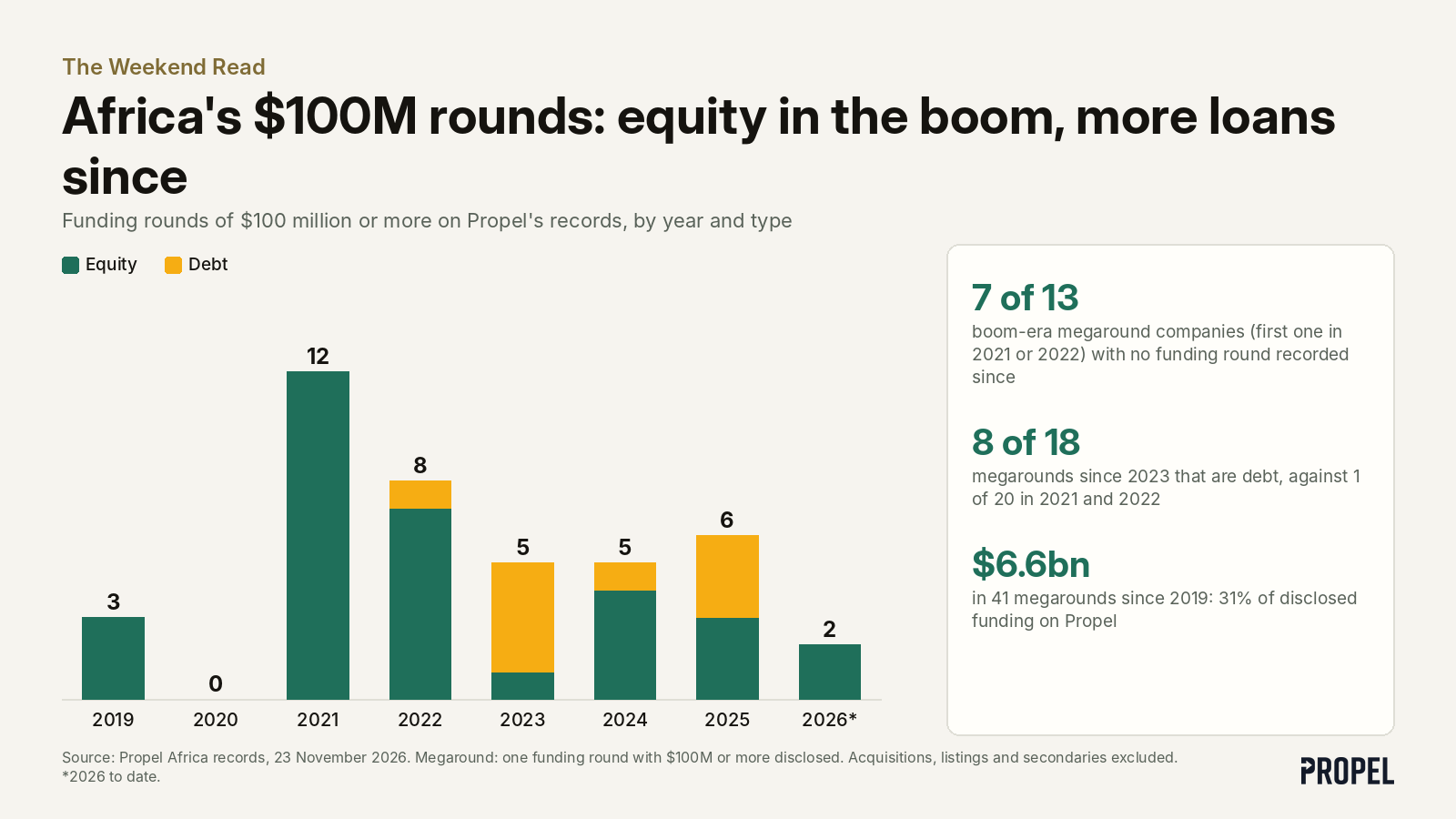
The years are uneven:
- 2019: three, all equity.
- 2020: none.
- 2021: 12, all equity.
- 2022: eight, seven of them equity.
- 2023: five, four of them debt.
- 2024: five, one of them debt.
- 2025: six, half of them debt.
- 2026 so far: two, both equity.
The class of 2021 and 2022
Thirteen companies raised their first megaround in 2021 or 2022, all of them equity: TymeBank, Flutterwave, Chipper Cash, PalmPay, MNT-Halan, Wave, onafriq (then MFS Africa), Jumo, TradeDepot, InstaDeep, Wasoko, Sun King and Yassir. Their equity megarounds in those two years add up to about $2.3 billion. Eleven of the 20 megarounds of 2021 and 2022 went to companies we class as fintech.
Several went back for more, fast. Chipper Cash raised $100 million in May 2021 and $150 million six months later. onafriq raised two $100 million Series C rounds seven months apart. Flutterwave's two came 11 months apart.
Then the records go quiet. From January 2023 onward, this is what Propel shows for the 13:
- Seven have no funding round recorded at all: Flutterwave, Chipper Cash, PalmPay, onafriq, TradeDepot, Wasoko and Yassir. For each of the seven, the megaround is the last round we have.
- One was sold. In January 2023 BioNTech bought InstaDeep for $446 million, a year after its $100 million Series B. BioNTech was already named on that round.
- Two raised debt only. Wave borrowed $137 million in June 2025 from four lenders including Norfund and British International Investment. Jumo took a $7.5 million loan from BlueOrchard in December 2025.
- Three raised equity again. TymeBank raised a $77.8 million Pre-Series C in 2023 and a $250 million Series D in December 2024. MNT-Halan raised $260 million in 2023 and $157 million in 2024. Sun King, after a run of loans, raised $40 million from Lightrock in December 2025.
So more than half of the class has no later round on Propel, and only three of the 13 have recorded new equity since 2022.
That is not the same as saying seven companies stalled. A company can grow on its own revenue and never need to raise again. Some raises are never announced. Some companies merge or restructure in ways a funding record does not show. We draw no conclusion about how any of these businesses is doing. What we can say is narrower: for seven of the 13, the megaround is the last raise we can see. We found a similar drop-off much further down the ladder when we asked how many African startups get a second round.
The money changed shape
The second finding is about what a megaround is now. In 2021 and 2022, 19 of the 20 were equity. Since the start of 2023, eight of 18 have been debt.
Three Kenyan solar companies took six of those 18. Sun King borrowed $150 million in 2023 and $156 million in 2025. M-Kopa borrowed $200 million in 2023. d.light borrowed $176 million in 2024 and then $300 million from Mirova in July 2025, the largest debt round on Propel. The one equity round among the six is M-Kopa's $166 million Series F in December 2025.
All three sell solar products, and the profiles of M-Kopa and Sun King describe them as financing what they sell, so customers pay over time. Lending suits a business that collects payments over months. d.light's $300 million loan alone is larger than any equity round on Propel since 2022.
The names on the cheques changed too. Tiger Global and Avenir Growth Capital are each on three megarounds on Propel, all in 2021 and 2022, and on none since. British International Investment is on six, five of them from 2023 onward. IFC is on four, three of them since 2023. The global growth funds that wrote the boom's largest equity cheques have not been back at that size on Propel. The most frequent name on African megarounds is now a development financier, and mostly as a lender.
Equity megarounds have not disappeared
There have still been ten equity megarounds since 2023, and they look different from the boom's.
- Moove, which finances cars for drivers on Uber's network, raised a $100 million Series B in February 2024 with Mubadala Investment Company and Uber, then a $250 million Series C in August 2026, the largest round of the year on Propel.
- Spiro, the electric motorbike maker recorded in Benin, raised $100 million from the Fund for Export Development in Africa in October 2025 and $215 million from the Investment Fund for Developing Countries and Equitane in June 2026.
- Moniepoint raised a $110 million Series C in October 2024 and a $90 million extension a year later.
- TymeBank's $250 million Series D, MNT-Halan's two rounds and M-Kopa's Series F.
- LXE Hearing, formerly HearX, raised $100 million from Patient Square Capital in April 2025, the only round on its profile.
Many of these companies arrived with longer records behind them. Moove has 12 funding rounds on Propel before its first megaround, many of them loans. d.light has 11. Eleven of the class of 2021 and 2022 had two or fewer, although our deal data starts in 2019, so earlier rounds are missing for companies founded before then.
The newer megaround companies also come back. Moove, Spiro, d.light, M-Kopa and Sun King each have two or more megarounds on Propel. Of the seven boom companies with no round since 2022, only Chipper Cash, Flutterwave and onafriq had a second, and each came within a year of the first.
What the data cannot tell us
These figures have real limits.
A missing record is not a missing round. We record what has been made public. Yoco's $100 million credit facility from Victory Park Capital, which we reported on 11 November, is not yet on its profile, so it is not in these counts.
258 funding rounds on Propel have no disclosed amount, and undisclosed is not zero. Some of them may be larger than $100 million.
Dates are recorded by month. Debt raised in local currency is converted at the rate the source reported, so a few figures near the line could fall either side of it.
Most of all, our data cannot say whether a megaround helped or hurt the company that took it. Valuations, revenue and what the money was spent on are not in our data. A company with no later round may simply not have needed one.
What the numbers do show is a change in what the biggest cheques in African venture are. In the boom they were equity, written largely by global growth funds, and for more than half of the companies that took them they are the last raise we can see. Since then, close to half of the biggest cheques have been loans, many of them to companies whose customers pay over time. Whether equity at that size returns, and to whom, is the question to watch.
You can check any of these figures yourself: look up a company on Propel, ask a question in Ask Propel, or download the Propel Dataset. For what happened at the other end of the journey, see who was in the room before the exit.
Source: Propel Africa records, export of 23 November 2026. A megaround is one funding round with $100 million or more disclosed. Funding excludes acquisitions, listings and secondaries; disclosed amounts only.