
Feature
Who was in the room before the exit? The backers behind Africa's recorded sales and listings
Of 215 African startups with an acquisition or listing recorded on Propel, 61 have an earlier funding round on record, and the same early-stage names keep appearing on them.
By AR Abdi · 2026-11-14
The Weekend Read, by AR Abdi
In January 2026, Flutterwave bought Mono, the Nigerian company that lets apps connect to customers' bank accounts. Propel records the price as $30 million.
Go back to Mono's first round on our records, a $500,000 seed in August 2020, and the names on it are Golden Palm Investments, LoftyInc Capital Management, Lateral Capital, Ventures Platform and RaliCap.
Three of those five turn up again and again when you look at the companies that were later sold or listed. So this piece asks a simple question. When an African startup exits, who was in the room before it happened?
Our first Weekend Read looked at the buyers. This one looks at the backers.
Most exits have no recorded backers
Propel has 215 African startups with an acquisition or a listing on record, from January 2019 to February 2026: 210 acquisitions and five listings.
Only 61 of them, or 28%, have an equity or debt round on Propel dated before the exit. The other 154 have none.
That gap matters more than any ranking below. Many of the companies bought were small, and small companies often never announce a round. Others raised before 2019, when Propel's deal records begin. Paystack, bought by Stripe for $200 million in 2020, is one: its earlier rounds sit outside our window, so it has no backers in this count.
Everything that follows is about the 61 exits where we can see who was there.
The names that keep appearing
Across those 61 companies we count 200 different named backers. Most appear once: 163 of them are on a single exit. Only 37 are on two or more.
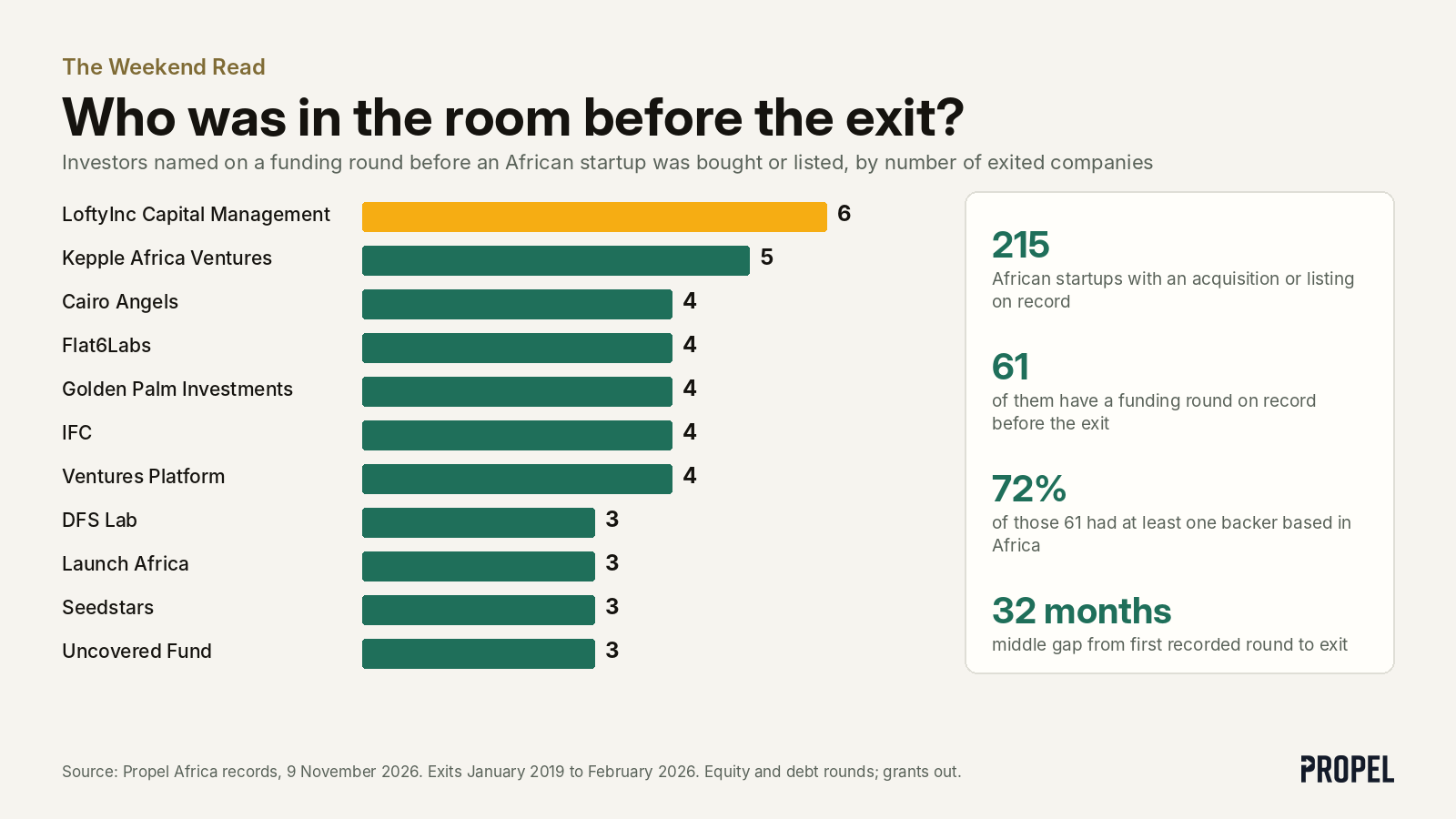
LoftyInc Capital Management leads with six. Its exited companies on our records are Anka in Côte d'Ivoire, Appetito in Egypt, Mono, PayDay in Rwanda, and Shyft Power and Vella Finance in Nigeria. In five of the six, LoftyInc was on the company's first recorded round.
Kepple Africa Ventures follows with five, all in East and West Africa: CoinAfrique in Senegal, then Mawingu, Mobius Motors and PayGo Energy in Kenya, plus Anka.
Five names have four each:
- Cairo Angels: Fatura, FilKhedma, Kashat and Orcas, all in Egypt.
- Flat6Labs: Elmawkaa, Opio and Welnes in Egypt, and Lamma in Tunisia.
- Golden Palm Investments: Appetito, Chaka, Mono and Traction.
- IFC: Adumo, Anka, CashPlus and Daystar Power.
- Ventures Platform: Brass, Mono, PayDay and Traction.
Three more early-stage names, DFS Lab, Launch Africa and Seedstars, have three each, as does Uncovered Fund.
In early, and mostly from the continent
Two patterns stand out.
The first is timing. Cairo Angels, Flat6Labs and Ventures Platform were on the first recorded round of every exited company in their count. These are angel networks, accelerators and seed funds, so they tend to arrive first by design. It also means that when a company on our records exits, its first recorded cheque often came from one of a small group of early names.
The second is where the backers are based. Of the 200, 59 have an African home base on their Propel profiles, 93 are based elsewhere and 46 are listed as global. By headcount, most are from outside the continent. By company, the picture flips: 44 of the 61 exits, or 72%, had at least one backer based in Africa.
The exits with a recorded backer also come from different places than exits overall. Across all 215, South Africa has the most, with 60. Among the 61 with a backer on record, Egypt leads with 17, then Nigeria with 11, Kenya with 10 and South Africa with six. Fintech is the largest sector, with 18.
Sometimes the room buys the company
In four of the 61 exits, a buyer was already a backer.
BioNTech was named on InstaDeep's $100 million Series B in January 2022 and bought the Tunisian AI company a year later for $446 million. Zip Co put $500,000 into Payflex in South Africa in April 2021 and bought it that September.
The other two look different. When Brass, the Nigerian business banking company, was sold in May 2024, the buyers on record were Ventures Platform, Paystack, PiggyVest and P1 Ventures. Ventures Platform had been on Brass's 2021 seed. When Sendchamp was sold in September 2023, DFS Lab and HoaQ were among the buyers, and both had backed it in 2021.
Four cases is too few to call a trend. They are a reminder that an exit is not always a stranger arriving with a cheque.
What the exits were worth, as far as we know
Propel has a disclosed price for 46 of the 215 exits. Only 12 of those also have disclosed money raised before. Here are the largest:
- InstaDeep: sold for $446 million; $107 million disclosed across two earlier rounds.
- PEG Africa, the Ghanaian solar company: sold to Bboxx for $200 million in 2022; $38 million across three rounds of equity and debt.
- Expensya in Tunisia: sold to Medius for $100 million in 2023; $20 million in one round.
- Adumo in South Africa: sold to Lesaka Technologies for $96 million in 2024; $26 million across two rounds, with IFC on both.
- Retail Capital in South Africa: sold to TymeBank for $83 million in 2022; $1 million in one round, from Crossfin.
- Mono: sold for $30 million; $17.6 million across four rounds.
It is tempting to divide one number by the other. We do not, and you should be careful too. A sale price is for the whole company, often partly in shares or paid over time. Money raised is what went in, not what any one backer owned. Neither tells you what an investor got back.
How long the room waited
For the 61, the middle gap between the first recorded round and the exit was 32 months, a little under three years.
- 20 exited within two years of their first recorded round.
- 27 took two to four years.
- 14 took four to six years.
None shows a gap of more than six years, but that is partly our window. A company first funded in 2015 and sold in 2024 appears here only from its first round since 2019, if it has one.
What the data cannot tell us
The biggest gap is the 154 exits with no recorded backer. Some of those companies bootstrapped. Some raised before 2019. Some raised and never said so. Our records cannot tell those apart.
We also cannot say who still held shares at the exit, who sold earlier, or on what terms. Being named on a round is not the same as being in the room on the day of the sale. And with most prices undisclosed, we cannot say which of these exits made money for their backers.
What the records do show is narrower and still useful. Where we can see the backers of an African exit, they were usually early, usually more than one, and in seven cases out of ten at least one of them was based on the continent.
How we counted
- An exit is a company's first recorded acquisition or listing. Swvl's 2021 SPAC merger counts as a listing. We removed two duplicate rows and one grant labelled as an acquisition.
- A backer is an investor named on an equity or debt round dated on or before the month of the exit. Grants, acquisitions, listings and secondary sales are not backing rounds.
- Home base is the country on the investor's Propel profile.
- Disclosed amounts only. Undisclosed is not zero. It is unknown.
- Acquisitions, listings and secondary sales are never counted as funding.
Source: Propel Africa records, export of 9 November 2026, exits dated January 2019 to February 2026.