
Feature
Africa's AI startups had their busiest year in 2025. Why have so few got past seed?
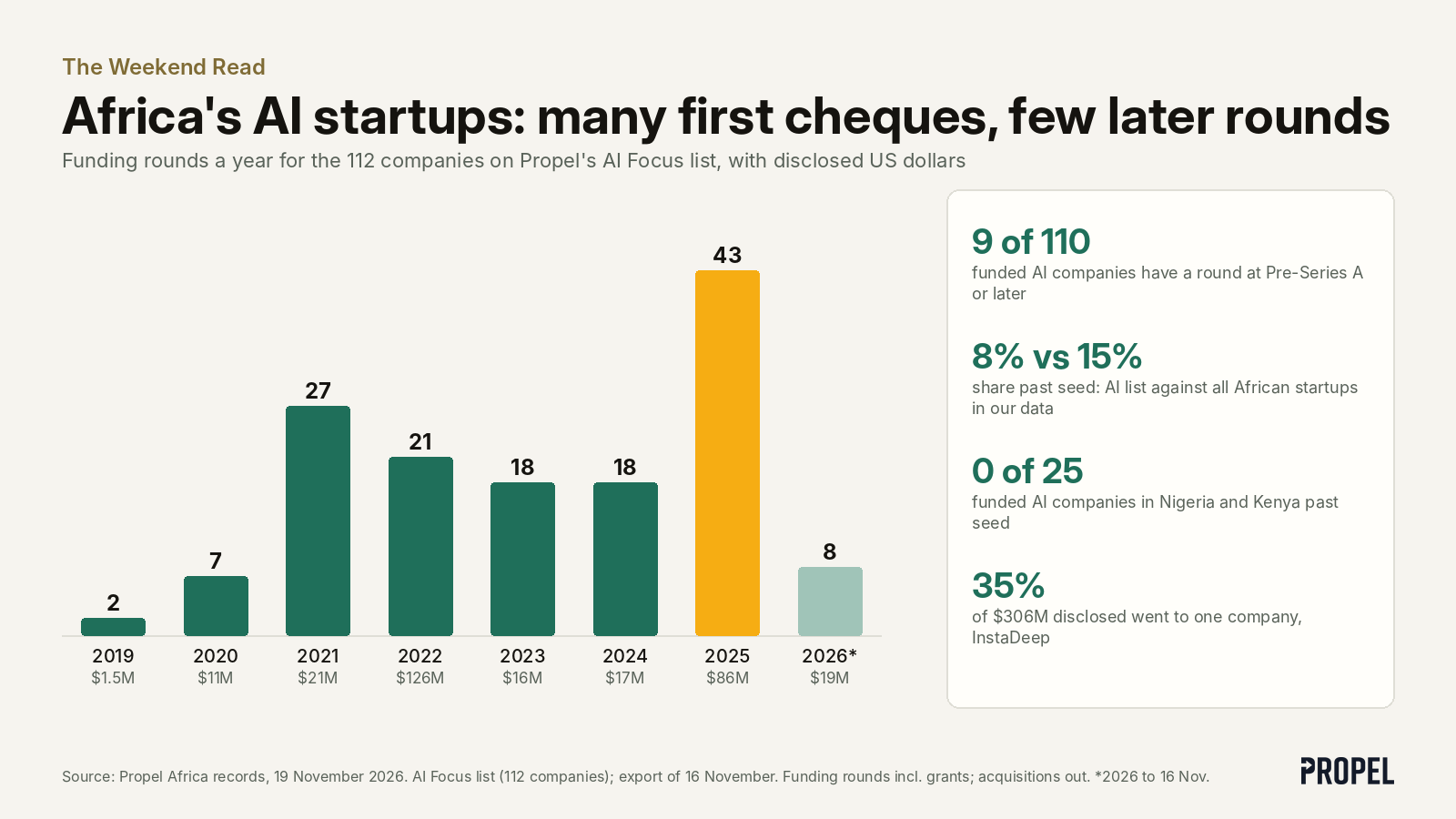
Of the 112 African startups building with AI on our list, 110 have raised money at least once, but only nine have reached a Pre-Series A round or later, about half the rate for African startups as a whole.
By AR Abdi · 2026-11-20
The Weekend Read, by AR Abdi
In September, Synapse Analytics, an Egyptian data science and machine learning company, raised a $13 million Series A from Algebra Ventures, Partech Africa and Silicon Badia. It is the largest round of 2026 so far among the companies on Propel's AI Focus list.
It is also rare. Synapse is one of only nine companies on that list with a round labelled Pre-Series A or later. The other 101 that have raised are, as far as our records show, still at pre-seed, seed or an early round with no stage given.
That is the tension in this week's numbers. Money into African AI startups has picked up sharply. The ladder above seed has barely moved. So this piece asks one question: where does the money for Africa's AI startups come from, and why does it stop so early?
A busy year
The AI Focus list holds 112 African companies where AI is the product, not a feature, each checked by the Propel team. On 19 November it shows about $306 million in disclosed funding.
2025 was the busiest year for these companies by a distance. We count 43 funding rounds across 41 companies, with $86 million disclosed. In 2023 and 2024 together there were 36 rounds and about $33 million.
The largest 2025 rounds were:
- Minexx, which prices and checks mining supply chains: $20 million from Jefferson Capital.
- InfiniLink in Egypt: a $10 million seed.
- Thunder Code, a Tunisian software testing platform: a $9 million seed.
- Cerebrium in South Africa: an $8.5 million seed with Y Combinator.
- Aydi in Egypt: a $7.5 million seed.
Four of those five are seed rounds. That is the first clue.
So far in 2026 we have eight rounds and $18.9 million, with Synapse more than two thirds of it. Our export runs to 16 November, so the year is not finished, and we draw no line from it.
One company, a third of the money
The $306 million is less than it looks. InstaDeep, founded in Tunisia, raised $107 million across two rounds: $7 million in 2019 and a $100 million Series B in 2022. That is 35% of all disclosed money on the list. Take it out and the other 111 companies share about $199 million.
The typical cheque is small. The middle disclosed equity round for AI companies on our list is $800,000. Across every African startup in our data it is $1 million.
The ladder stops early
Of the 110 AI companies with a funding round, nine have reached Pre-Series A or later. That is 8%. Across the 2,420 African startups with a funding round in our data, the share is 15%.
The nine are spread across four countries:
- South Africa: DataProphet, Locstat, Plentify and Xineoh.
- Egypt: DXwand, Synapse Analytics and Widebot.
- Morocco: Atlan Space.
- Tunisia: InstaDeep.
Nigeria and Kenya are the striking gap. Between them they have 25 funded AI companies on the list, and none has a round past seed. Nigeria's 14 have about $22 million disclosed; the largest single round is Indicina's $3.8 million in 2021. Kenya's 11 have $4.3 million in total, and the largest round is a $1.5 million seed for BYON8 in 2021.
Egypt and South Africa, by contrast, account for 50 of the 112 companies, about $120 million of the money and seven of the nine that have climbed.
There is a fair explanation for part of this. Many of these companies are young. Their middle founding year is 2020, and 39 of the 110 had their first funding round in 2025 or 2026. A company that raised its seed last year would not usually be raising a Series A yet. We have written before about how many African startups get a second round, and the answer then was fewer than four in ten.
Grants open doors, equity pays the bills
It is easy to assume that grants carry African AI. Our numbers say something narrower.
We have 22 grants on the list, to 21 companies. Together they are worth about $3 million, 1% of the disclosed money. For 15 companies, a grant is the only funding we have. Grants make up 15% of the list's rounds, close to the 17% for all African startups, so AI companies are not unusually reliant on them.
Where grants matter is at the very start, and in a few countries. In Kenya, six of the 16 AI rounds are grants. In Tanzania, all four are. DEG is on four grants to AI companies, and the GSMA Innovation Fund and GIZ on three each.
Sometimes a grant comes first and equity follows. Cybervergent, a Nigerian company that automates cybersecurity with AI, had GIZ grants in December 2024 and December 2025, then a $3 million seed in March 2026 from Ventures Platform and Atlantica Ventures. One case shows that the path exists, not how often it is taken.
Who is paying
We count 191 named investors on funding rounds for these companies. 78 have an African home base on their Propel profiles, 80 are based outside the continent and 32 are listed as global. By company, the African share is larger: 64 of the 100 AI companies with a named investor have at least one Africa-based backer.
The most frequent names are early-stage specialists:
- Launch Africa: 10 companies.
- Flat6Labs: six, five in Egypt and one in Tunisia.
- 54 Collective: six.
- LoftyInc Capital Management, Silicon Badia, Y Combinator and DEG: four each.
These are the names that write first cheques by design, and they are doing it widely. The question the data raises is who writes the third and fourth. The nine companies past seed drew on a different set: Algebra Ventures, Partech Africa and Shorooq Partners at the Egyptian companies, and Knife Capital and the Industrial Development Corporation of South Africa at DataProphet.
Where the big outcomes went
Two of the three largest sums connected to this list are not funding at all. They are sales, and we never count them as money raised.
In January 2023 BioNTech bought InstaDeep for $446 million. BioNTech was already in the room: it is named on InstaDeep's 2022 Series B. In September 2024 Xero bought Syft, the South African financial reporting platform for small businesses, for $70 million. And in November 2025 GlobalFoundries bought InfiniLink, the Egyptian maker of optical connectivity chips for AI data centres, seven months after its $10 million seed, for a price that was not disclosed.
None of the three buyers has an African home base on its Propel profile. For founders and early backers, that is a real result. For the ladder of local growth rounds, it means some of the strongest candidates leave it early. Our earlier piece on who was in the room before the exit looks at that pattern across every sector.
What the data cannot tell us
Several things limit what these figures can say.
The list is a selection. It holds companies where AI is the product, checked one by one. Many startups use AI in some part of their service and are not on it, and a different line would give different totals.
66 of the 144 funding rounds on the list carry no stage, only "Venture Round". Some of those may be later rounds. Minexx's $20 million is one example. If even a few are, the past-seed count rises.
Six rounds have no disclosed amount, and undisclosed is not zero. Our deal data starts in 2019, so earlier rounds are missing.
Most of all, the numbers cannot tell us why. A thin ladder could reflect the age of these companies, their revenue, the size of their markets, or how investors judge AI businesses that sell to African customers. Our records show where the money has gone, not what decided it.
What they do show is a sector that has found its first cheques. Whether it finds the rest is the question to watch.
You can check any of these figures yourself: browse the AI Focus list, ask a question in Ask Propel, or download the Propel Dataset.
Source: Propel Africa records, export of 16 November 2026, and the AI Focus list on 19 November 2026. Funding excludes acquisitions, listings and secondaries; disclosed amounts only.