
When an investor agrees to back your company, the next question is how the cheque is written. There are three common ways: a SAFE, a convertible note or a priced round. They can move the same amount of money, but they leave you with very different paperwork, costs and ownership.
This chapter of the Propel Guide explains how each one works, with examples from African startups. The activity figures come from Propel Africa's deal records from 2019 to August 2026.
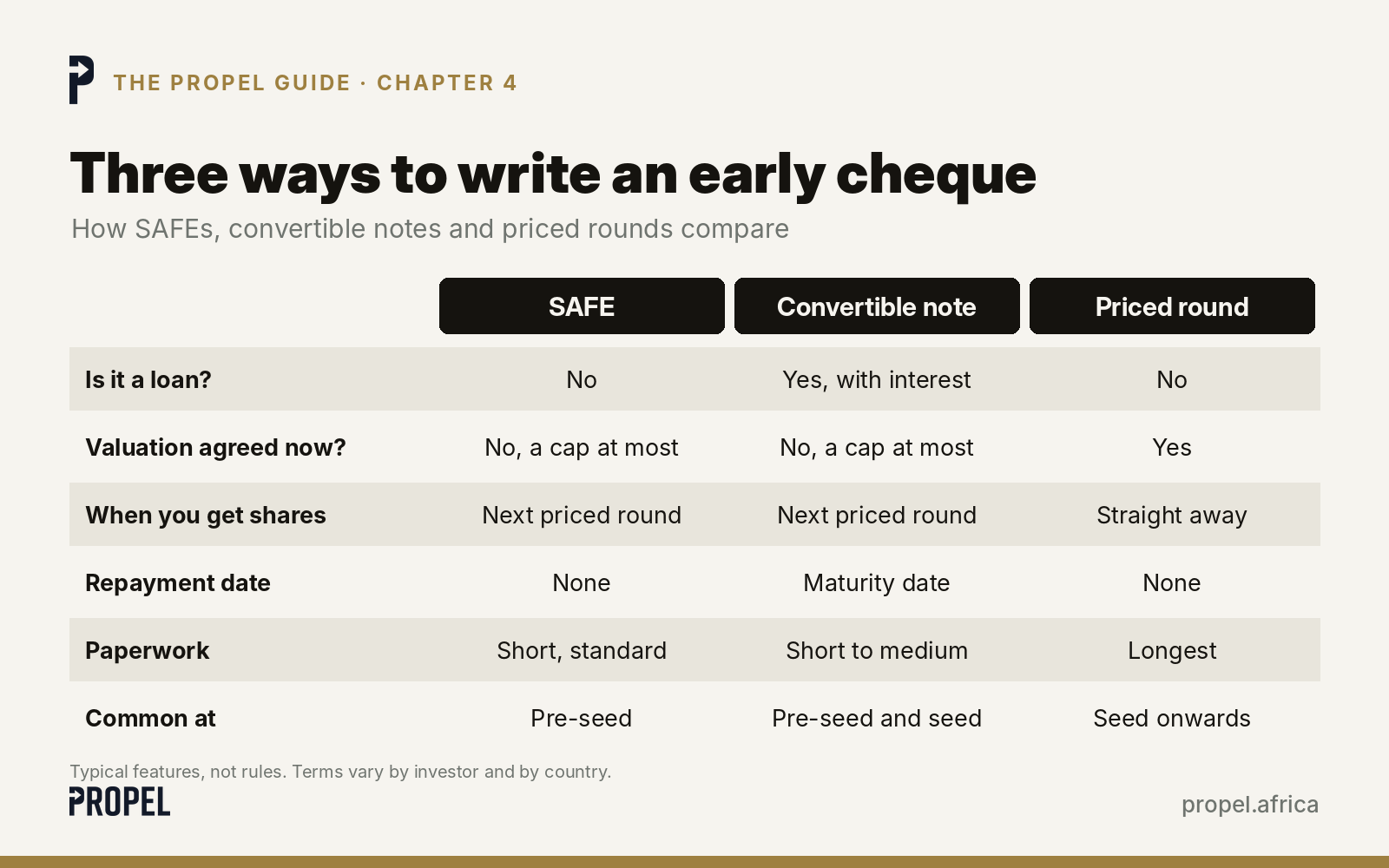
The question underneath: what is the company worth?
A priced round needs an answer to that question today. At pre-seed there is often little to go on: no revenue, a small team and a product that may change. SAFEs and convertible notes let founders and investors put off that question. The investor hands over money now and receives shares later, at the next priced round, on terms agreed in advance.
Priced rounds: agree the value, sell the shares
In a priced round, founders and investors agree a valuation and the investor buys new shares at a set price. The terms go into a term sheet, then a subscription agreement and usually a shareholders' agreement covering board seats, information rights and investor protections.
Some companies price a very early round. Charikaty, a Moroccan legal tech company, raised a pre-seed round in September 2026 at a reported valuation of €3 million, with Red Tape Ventures and angel investors. From Series A onwards, most rounds are priced.
What it costs you: legal fees and time, often several weeks of negotiation and paperwork. You give up a known share of the company on day one.
When it fits: larger rounds, a lead investor who wants full rights, and any company with enough traction to argue for its value.
SAFEs: shares later, no loan
A SAFE, or simple agreement for future equity, gives the investor the right to shares at the next priced round. It is not a loan, so there is no interest and no repayment date. Y Combinator introduced the SAFE in late 2013 and a "post-money" version in 2018, which is the version its own standard deal uses.
A SAFE usually has one or more of these terms:
- **Valuation cap.** The highest valuation at which the SAFE converts. On a post-money SAFE, the investor's stake is simply the amount invested divided by the cap: $500,000 at a $5 million cap buys 10%.
- **Discount.** A reduction on the price new investors pay at the priced round.
- Most favoured nation (MFN). A promise that if you later sign SAFEs on better terms, this investor gets those terms too.
The best-known SAFEs in Africa come from the global accelerators. Y Combinator's standard deal is $500,000: $125,000 on a post-money SAFE for 7% of the company, plus $375,000 on an uncapped SAFE with an MFN clause. Techstars moved to a similar model in 2025: $20,000 for 5%, plus $200,000 on an uncapped MFN SAFE.
What it costs you: very little to sign. The real cost comes later, at conversion, and it can be larger than founders expect (see "Watch the stack" below).
When it fits: small, fast rounds from angels and accelerators, and money raised in instalments from several investors.
Convertible notes: a loan that turns into shares
A convertible note is a loan that converts into shares at the next priced round, usually with a cap, a discount or both. Unlike a SAFE, it carries interest, which normally converts into shares too, and it has a maturity date. If no priced round happens by then, the investor can, in principle, ask for the money back.
Until 2025, Techstars' standard deal included a $100,000 convertible note alongside $20,000 for equity. Development funders and impact investors use convertible instruments too, often in larger amounts:
- Complete Farmer in Ghana secured a $2.4 million convertible loan led by IFC with BIFT, a programme of the Global Agriculture and Food Security Program, in September 2026.
- Village Capital backed VDL Fulfilment in Ghana in May 2026 with a blend of a convertible note and milestone-based debt.
- In Francophone Africa, convertible bonds play a similar role. Julaya in Côte d'Ivoire raised CFA 800 million in October 2025, and Izili secured $5 million from FEI-OGEF in January 2026.
- In 2022, All On gave each of 13 Nigerian energy enterprises $50,000 in convertible debt, alongside grant money from other funders.
What it costs you: interest, and the risk of a repayment demand if the next round is slow to come. Notes take a little more paperwork than a SAFE.
When it fits: investors who want the protection of a loan, such as development funders, and companies whose holding company is in a country where a SAFE is awkward to use.
Watch the stack
SAFEs and notes feel cheap because nobody's ownership changes when they are signed. It changes all at once at the priced round, when every SAFE and note converts together. Founders who raise several SAFEs at different caps can find they own much less than they assumed.
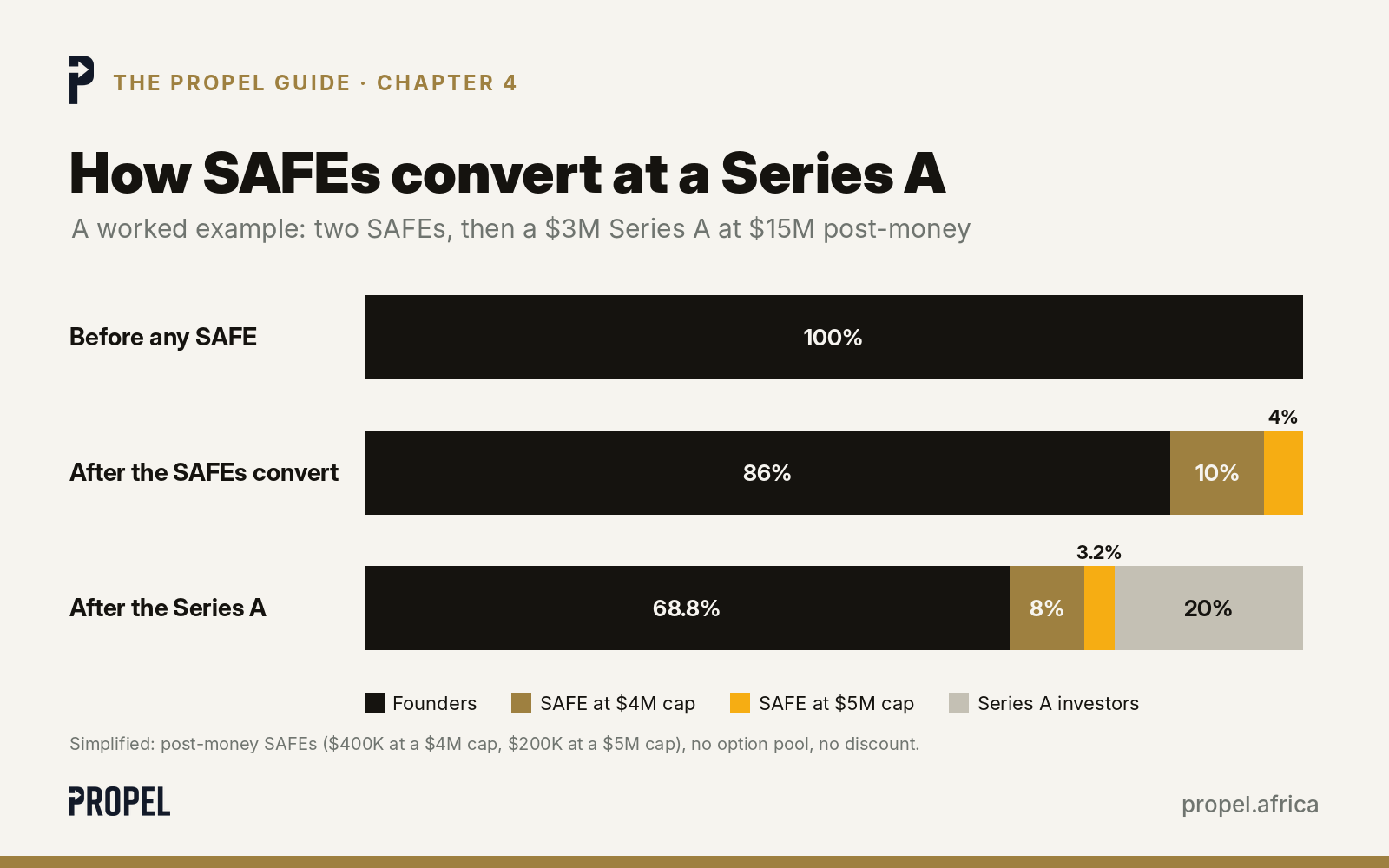
In the example above, the founders raise $400,000 on a SAFE at a $4 million cap and $200,000 at a $5 million cap. Those investors own 10% and 4%, so the founders hold 86% going into the Series A. A $3 million Series A at a $15 million post-money valuation then sells 20% to new investors, and the founders finish with about 69%. The SAFE investors keep about 11%.
Two habits help. Keep a simple cap table that shows what every SAFE and note will convert into. And model the next round before you sign another SAFE.
SAFEs and where your company is registered
The SAFE was written for US companies. Y Combinator's own forms cover companies formed in the US, Canada, the Cayman Islands and Singapore, and it advises getting advice from a lawyer in the country where the company is formed. Some African startups have a US or other offshore holding company: Complete Farmer, for example, has a parent company incorporated in Delaware. A company registered only in Nigeria, Kenya, Egypt or elsewhere should check with a local lawyer whether a SAFE works under local law, or use a convertible note or a small priced round instead. The glossary explains the flip and the reverse flip.
Fewer accelerator cheques than in 2021 and 2022
The accelerator SAFE was a common first cheque for African startups a few years ago. In Propel Africa's records, 30 African startups received their first Y Combinator investment in 2021 and 31 in 2022. Since then the number has been six or fewer a year. Techstars' first cheques fell from 54 in 2023 to two in 2025, as Techstars cut back worldwide and closed its Lagos accelerator with ARM Labs in late 2024.
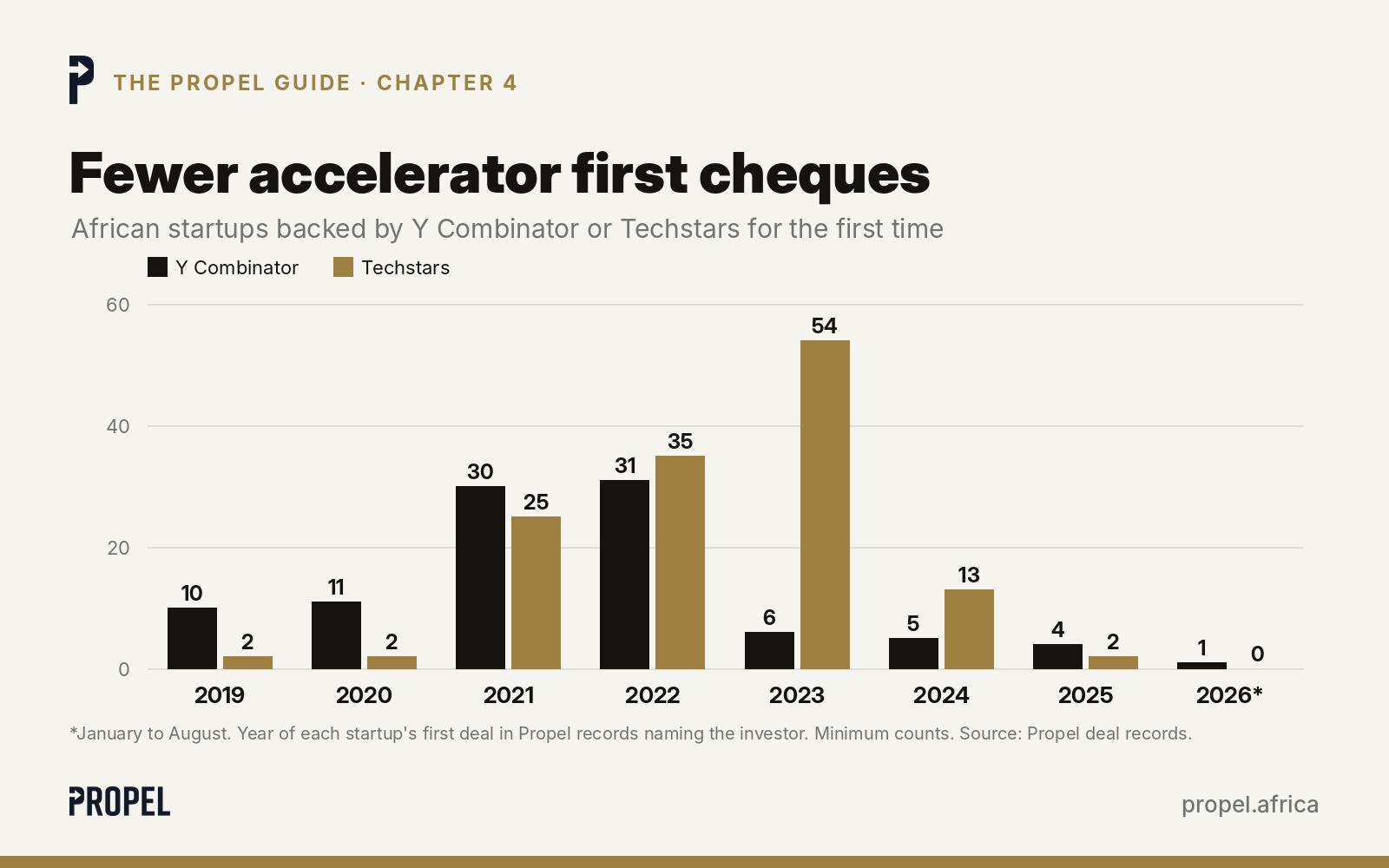
African founders can still apply to both programmes. But for many companies the first cheque now comes from angels, local accelerators and seed funds, on a mix of SAFEs, notes and small priced rounds.
Choosing what fits
- A small round from angels or an accelerator, raised quickly: a SAFE, if your company structure allows it.
- An investor who wants the protection of a loan: a convertible note.
- A larger round with a clear lead investor, or real traction: a priced round.
- Whatever you choose: a cap and discount you would be happy to see on every later SAFE, and a cap table that shows the effect.
Every profile on Propel Africa lists each funding round and the investors behind it, so you can see how companies like yours raised their early money.
How we measured
Figures on first cheques count each startup once, in the year of its first deal in Propel Africa's records (2019 to August 2026) that names Y Combinator or Techstars as an investor. Some programmes do not announce every company, so these are minimum counts. The terms of the Y Combinator and Techstars standard deals are taken from the investors' published terms and from reporting by Launch Base Africa and Daba Finance. This chapter explains how the instruments work in general and is not legal advice: the right documents depend on where your company is registered.
Next in the Propel Guide: valuation and dilution. New to a term? See the glossary.