
Every priced round answers two questions at once: what is the company worth, and how much of it do the new investors get? The answers decide how much of your company you still own when it matters.
This chapter of the Propel Guide explains how valuation and dilution work, with examples from African rounds where the terms were made public. Most African startups do not disclose their valuations, so the worked examples here are illustrations, labelled as such.
Pre-money and post-money
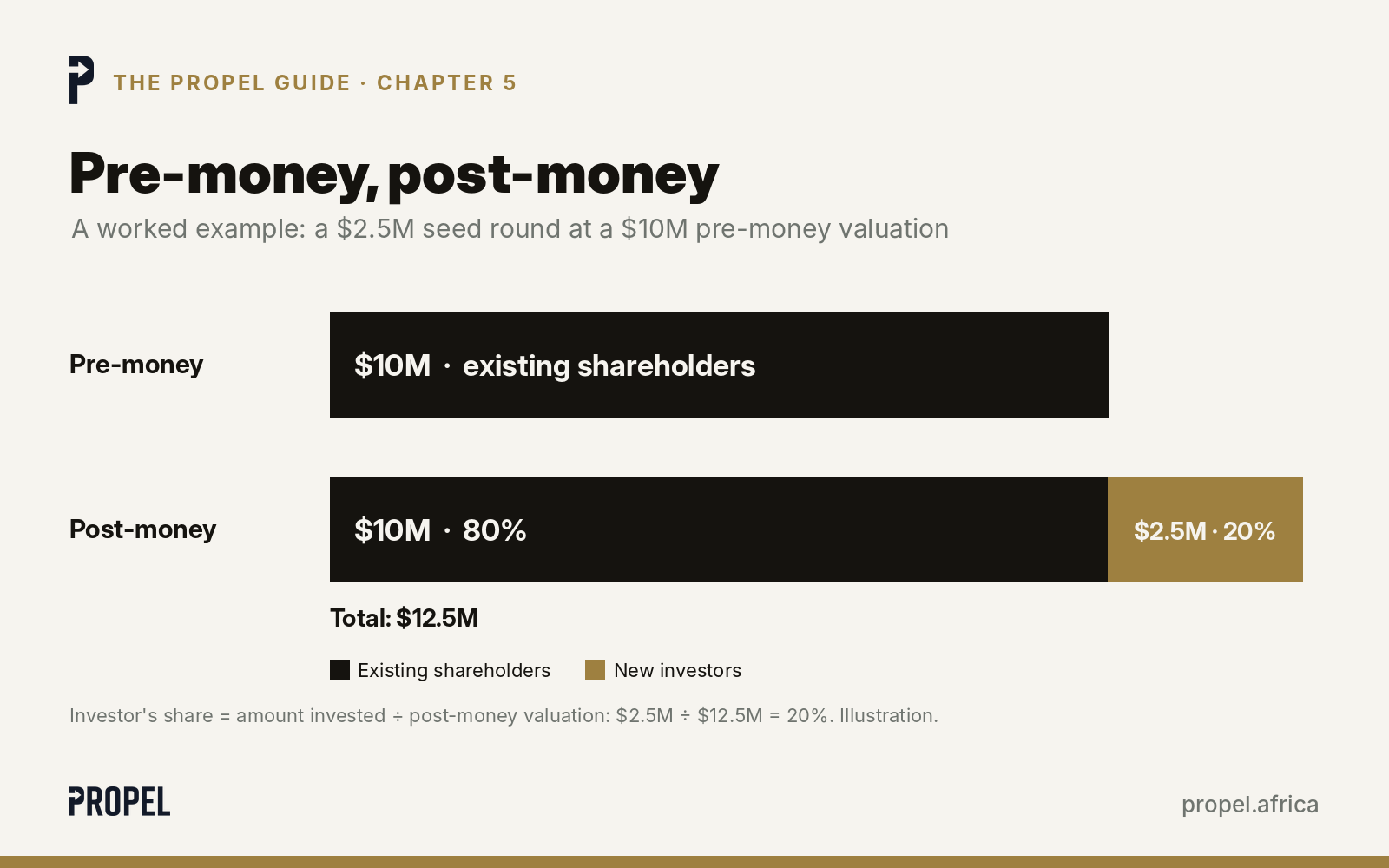
The pre-money valuation is what the company is worth before the new money arrives. The post-money valuation is the pre-money plus the new money. The investor's share is simply the amount invested divided by the post-money valuation.
Two public examples show the arithmetic:
- In December 2024, Nubank's parent company Nu Holdings invested $150 million for 10% of Tyme Group, the parent of TymeBank, as part of a $250 million Series D that valued the group at $1.5 billion.
- In May 2026, Sanlam Alternative Investments paid $10 million for 10% of Africa GreenCo, the Zambian renewable energy trader. That implies a value of about $100 million for the whole company.
How valuations are set
There is no formula. At the early stages, a valuation is mostly a negotiation over two numbers: how much the company needs to raise, and what share the founders are willing to sell. If a company needs $2.5 million, a typical seed round in Africa today (see chapter 1), and the founders want to sell no more than 20%, the post-money valuation has to be at least $12.5 million.
Investors then test that number against what they can see: revenue and growth, the size of the market, the strength of the team, what similar companies raised at, and how many other investors want in. Competition for a round is one of the biggest levers founders have.
Later, valuations lean more on numbers. Fast-growing companies are often valued as a multiple of revenue, and companies close to a listing are compared with listed peers. Morocco's Cash Plus was valued at about $550 million in its stock market listing, which closed in November 2025. Its shares began trading on the Casablanca Stock Exchange in December.
Dilution: a smaller slice of a bigger cake
Dilution is the fall in each existing shareholder's percentage when new shares are issued. It is not a loss in itself. If the round raises the value of the company enough, a smaller share can be worth far more.
It does add up, though. Each round sells a slice, and the slices compound.
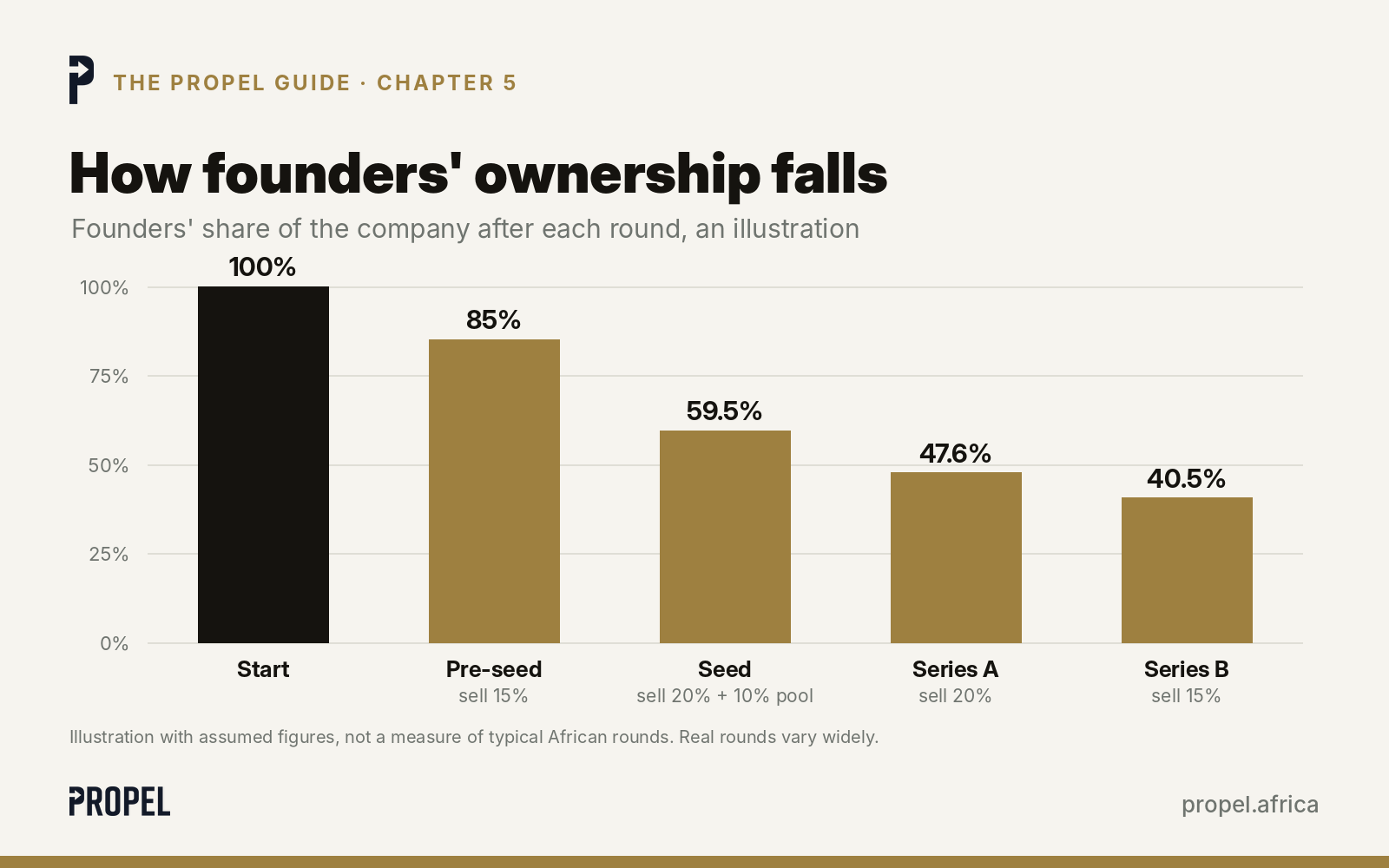
In the illustration above, founders sell 15% at pre-seed, 20% at seed with a 10% option pool created at the same time, then 20% at Series A and 15% at Series B. They finish with about 40% of the company. Every number in that chain is an assumption, but the shape is common: the biggest falls come early, when valuations are lowest.
The option pool
An option pool sets aside shares to reward employees. Investors usually ask for it to be created or topped up before their money comes in, so the cost falls on existing shareholders, mostly the founders, rather than on the new investors. A 10% pool created "pre-money" can cost founders more than the headline valuation suggests. It is worth negotiating the size of the pool against a real hiring plan.
SAFEs and notes count too
SAFEs and convertible notes do not dilute anyone when they are signed, but they all convert at the next priced round. Chapter 4 shows how a stack of SAFEs at different caps can take a large bite at the Series A. Model them together with the new round, not one at a time.
When the value goes down
Not every round values the company higher than the last. A down round sets a lower price per share, and a flat round keeps it the same. Some investors offer a structured round instead: a headline valuation that holds, with extra protections underneath.
Two terms decide who carries the cost:
- **Anti-dilution protection** gives earlier investors extra shares if a later round is priced lower. The cost falls on shareholders without that protection, usually the founders and employees.
- **Liquidation preference** decides who gets paid first, and how much, when the company is sold. A large preference can mean founders receive little from a sale even at a respectable price.
A high valuation with heavy protections can leave founders worse off than a lower, cleaner one.
The billion-dollar end
At the top, valuations make headlines. In Propel Africa's records, recent rounds at or above $1 billion include Moniepoint, which stayed above $1 billion after completing a $200 million round in October 2025, MNT-Halan at $1.4 billion in June 2026, and Moove, which raised a $250 million Series C at $2.1 billion in August 2026. These companies are rare. For almost every founder, the earlier rounds decide far more about how much of the company they keep.
Before you sign
- Necessary: know your cap table, including every SAFE and note, and model the round before you agree to it.
- Necessary: read the terms behind the headline: option pool, liquidation preference and anti-dilution.
- Good to have: raise only what you need to reach the next clear milestone, so the next round is priced on stronger numbers.
- Good to have: talk to founders who have raised from the same investor. Every investor profile on Propel Africa lists the companies it has backed.
How we measured
Most African startups do not disclose their valuations, so this chapter uses rounds where the terms were reported publicly: Tyme Group (TechCrunch, December 2024), Africa GreenCo (Engineering News, May 2026), Cash Plus (Launch Base Africa, November 2025), Moniepoint (Launch Base Africa, October 2025), MNT-Halan (Wamda, June 2026) and Moove (company announcement, 5 August 2026). The dilution chart is an illustration with assumed figures, not a measure of typical African rounds. This chapter explains general principles and is not legal or financial advice.
Next in the Propel Guide: term sheets, line by line. New to a term? See the glossary.