Feature
Who writes Africa's first cheque now?
Y Combinator and Techstars backed far fewer African startups after 2022. Propel Africa's records show who filled the gap, and how first cheques moved closer to home.
By AR Abdi · 2026-11-21
For a few years, the surest route to a first cheque for an African founder ran through a famous American accelerator. In 2021 and 2022 that route was wide open. Then it narrowed, and quickly. I went back through every announced deal in Propel Africa's records, from January 2019 to August 2026, to see who writes the earliest cheques now.
Our records cover announced deals. They are not a census, and some programmes do not announce every company they back, so every count below is a minimum. Coverage of small rounds is thinner for 2019 and 2020, so I mostly compare from 2021.
The numbers behind the retreat
Start with the two names everyone knows. In Propel Africa's records, 30 African startups had their first deal naming Y Combinator in 2021 and 31 in 2022. In 2023 that fell to 6, then 5 in 2024, 4 in 2025 and just 1 between January and August 2026. Our batch labels agree: 37 startups carry a 2022 YC batch, and 11 carry batches from 2023 to 2025 combined.
Techstars kept growing a year longer, reaching 54 newly backed African startups in 2023, then dropped to 13 in 2024, 2 in 2025 and none so far this year.
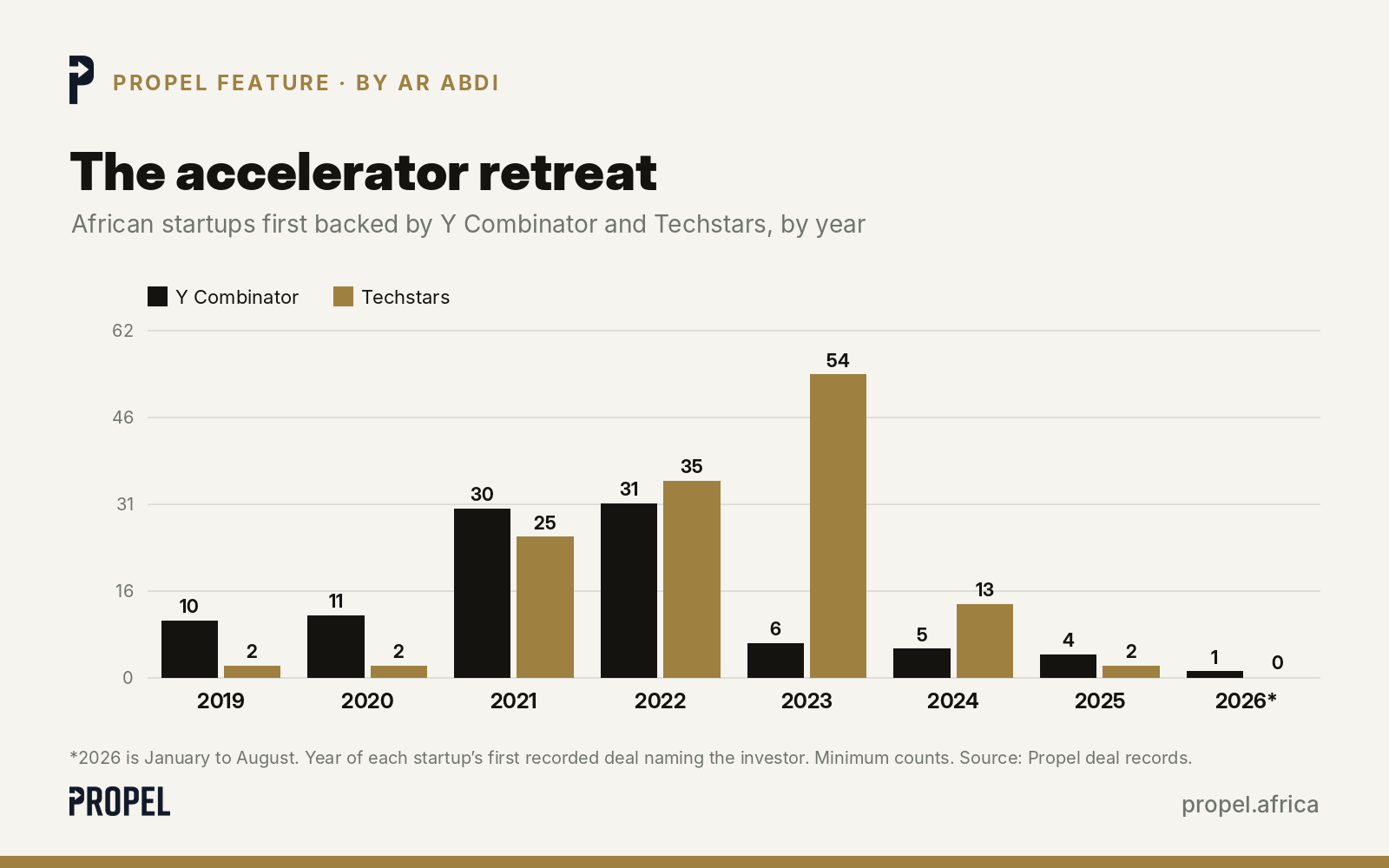
Together they newly backed 121 African startups across 2021 and 2022, and 24 across 2024 and 2025. In 2022, YC or Techstars sat in the line-up of 70 of the 511 startups we recorded raising a pre-seed, seed or sub-$1 million round. In 2025 it was 7 of 231.
Bigger cheques, fewer African names
The odd part is that both accelerators now invest more per company. YC's standard deal is $500,000: $125,000 on a post-money SAFE for 7%, plus $375,000 on an uncapped SAFE with a most favoured nation clause. It moved to that structure in January 2022, up from $125,000 for 7%. Techstars invests $220,000 per company from its autumn 2025 cohorts, made up of $20,000 for 5% and a $200,000 uncapped SAFE.
So the cheques grew while the African share shrank. Techstars is the clearer case. Its Lagos accelerator with ARM Labs launched in December 2022, ran two cohorts, backed 24 startups and closed in late 2024 as part of a global restructuring, according to Launch Base Africa. It shows in our data: of the 58 African startups with a Techstars deal recorded in 2023, 35 were Nigerian.
Google followed a similar path. Its Black Founders Fund, which offered up to $100,000 in equity-free cash per startup, appears for 59 startups in 2022, 27 in 2023, none in 2024 and 3 in 2025.
I don't read this as a verdict on African founders. Global programmes cluster where their capital and partners sit, and when they consolidate, the edges go first. For many of them, Africa is an edge.
Who stepped in
Digital Africa, a public-private initiative whose Fuzé vehicle writes tickets of €20,000 to €100,000 at pre-seed or seed, went from 3 startups in our records in 2023 to 19 in 2024 and 22 in 2025. That made it our most active early-stage investor last year, mostly through cheques of about $100,000 into companies such as Swyft in Cameroon. Launch Base Africa counted 29 Digital Africa deals in 2024 against our 19, a useful reminder that our numbers are floors.
Specialist pre-seed funds have grown too. Catalyst Fund, run by BFA Global, invests $200,000 at pre-seed in climate resilience companies. It appears for 8 startups between January and August 2026, up from 2 in the same months of 2025. Madica, the pre-seed programme Flourish Ventures launched with $6 million set aside for investment, writes $200,000 cheques. Eight of its ten deals in our records since January 2025 are exactly that, from Motherbeing in Egypt to Kilimo Fresh in Tanzania.
Several of the busiest names are based on the continent. Launch Africa, headquartered in Mauritius, topped our early-stage tables in 2021 and 2022, slowed to 12 startups in 2025, then picked up sharply: 21 startups between January and August 2026, against 9 in the same months of 2025. WeeTracker reported 15 new Launch Africa investments in the first half of 2026. Most amounts are undisclosed, so we estimate them from its usual ticket. Axian, the pan-African group that began in Madagascar, has a venture arm writing initial cheques of roughly $50,000 to $500,000; it appears for 13 startups in 2025, up from 6 in 2023. Chui Ventures, which closed a $17.3 million first seed fund in December 2025, appears for 8 startups in 2025, up from 3 in 2023.
Grants have held steady while equity thinned. We recorded 149 startups receiving a grant in 2022 and 153 in 2025. About a quarter of the startups that entered our records in 2024 and 2025 did so with a grant, up from 15% in 2022. Nigeria's Co-Creation Hub runs the Mastercard Foundation EdTech Fellowship, whose fourth cohort of 12 Nigerian startups, announced in July 2026, gets up to $100,000 each in equity-free funding over 18 months. TRANSFORM, the impact accelerator led by Unilever, the UK Government and EY, gave grants to 10 startups in our 2025 records, and the Jack Ma Foundation's Africa's Business Heroes prize, which shares $1.5 million among ten finalists each edition, to 20 across its 2024 and 2025 editions.
Not every local name grew. Flat6Labs fell from 47 startups in 2022 to 3 in 2023, and Future Africa from 38 to 4. 54 Collective went from 23 in 2024 to 3 in 2025. The retreat was not only a foreign one.
The first cheque moved closer to home
The clearest pattern is where the earliest investors are based. Using each investor's listed headquarters, I looked at every pre-seed, seed and sub-$1 million round.
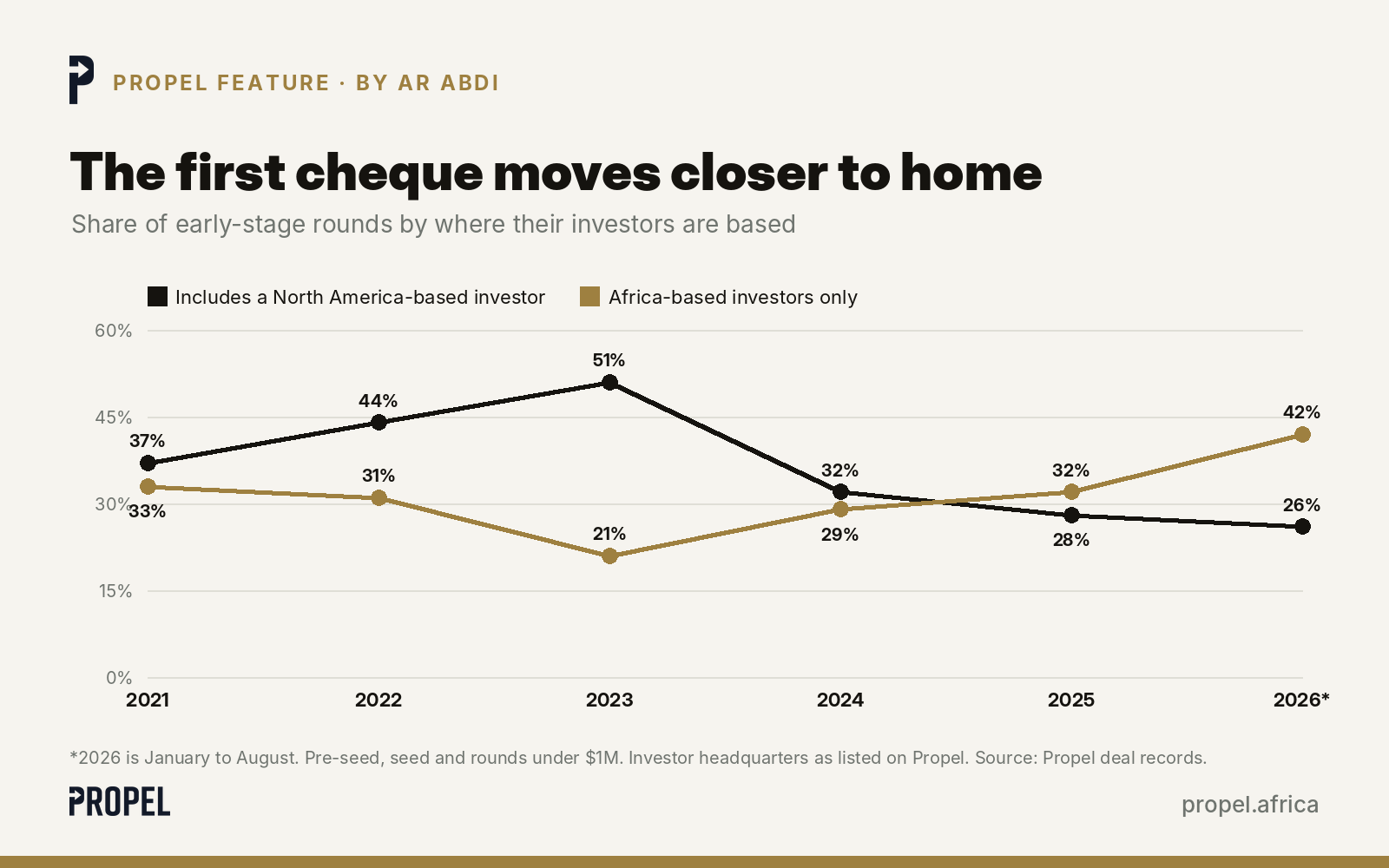
In 2023, 51% of those early rounds included at least one investor headquartered in North America. By 2025 that was 28%, and so far in 2026 it is 26%. Over the same period, the share of early rounds where every identified investor is based in Africa rose from 21% to 32%, and to 42% in the first eight months of 2026. Headquarters can blur the picture: Digital Africa, based in France, counts as European here, while Catalyst Fund and Madica, both listed with Kenyan headquarters, are backed by US-based organisations.
These cheques stack. Agrails, a Kenyan agriculture startup, took $0.2 million from Catalyst Fund in December 2025. Six months later it raised a $3.2 million seed round with Catalyst Fund, Axian and Enza Capital among the investors.
There is a cost: early-stage activity is well below the 2022 peak. We recorded 511 startups raising at this stage in 2022, 231 in 2025 and 122 between January and August 2026, compared with 169 in the same months of 2025. Recent months tend to fill in as announcements surface, so I would not read too much into 2026 yet.
What this means for founders
The global accelerator is no longer the default first step for an African startup, and founders should plan as if it will not be available to them. What replaced it is closer and more specialised, but the cheques are usually smaller and the investors more scattered.
In practice, three things follow. First, build a list of local and sector-specific first-cheque investors rather than pinning everything on one long-shot application. A climate founder in Nairobi has a very different shortlist from a fintech founder in Lagos. Second, take grants seriously. For about a quarter of new companies in our records, a grant is the first outside money. Third, expect your first round to be stitched together from two or three smaller cheques, and keep clean records of each, because the next investor will ask.
The big accelerators have not gone for good, and their larger cheques are still worth chasing. But more and more of Africa's first cheques now come from investors based on the continent, and I think that is a healthier place to start from.