
Feature
Who buys African startups? What 210 acquisitions on our records show
Propel's records hold 210 African startups bought since 2019: six in ten deals had a buyer based in Africa, and one in three was bought by another startup.
By AR Abdi · 2026-10-24
The Weekend Read, by AR Abdi
This week brought two exit stories from companies on Propel's records. On Tuesday, MNT-Halan began trading on the Egyptian Exchange, after offering 320 million shares, a fifth of the company, at EGP24.5 each (Ahram Online). Last month, Five35 reported a 3.5x return and a 38% internal rate of return on its stake in Ghana's Complete Farmer, after a four-year hold (Innovation Village).
Exits are how investors get their money back, and how founders and early staff turn years of work into something they can spend. They are also the part of African venture that gets counted least. So this Weekend Read asks one question of our records: when an African startup is sold, who buys it?
What we counted
Propel's records hold 212 acquisitions of 210 African startups between January 2019 and February 2026. That is the set this piece works from.
Three things to keep in mind. First, an acquisition is not funding. Neither is a stock market listing or a secondary sale, where one shareholder sells to another. None of the figures below are part of any funding total we publish. Second, most deals never state a price. Undisclosed does not mean zero. Third, acquisitions recorded so far in 2026 run only to February, so 2026 is not comparable with full years.
Most buyers are already on the continent
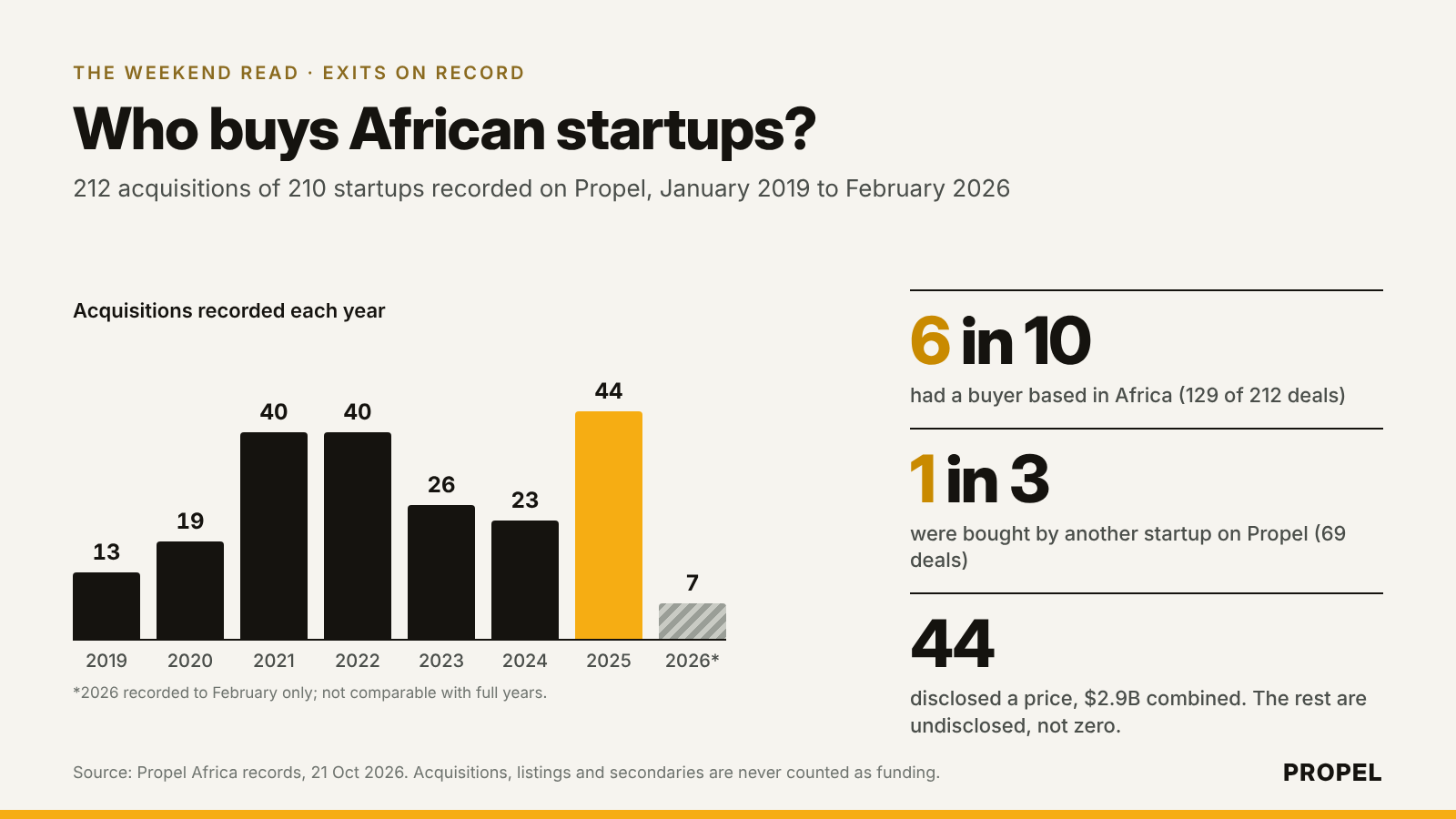
Of the 212 deals, 129 had at least one buyer based in Africa. That is six in ten. Another 62 had buyers based elsewhere, and 20 were bought by multinationals that our records list as global rather than tied to one country.
Looking at the first-named buyer, South Africa is home to the most (45), followed by Nigeria (32), Egypt (22) and Kenya (13). Outside Africa, the United States leads with 28, then the United Kingdom (11), the United Arab Emirates (9) and France (6).
South Africa shows the pattern most clearly. Established financial firms there have been steady buyers of younger fintechs. Lesaka Technologies bought Adumo for $96 million in 2024 and Bank Zero for $61.4 million in 2025. In 2025 Nedbank bought iKhokha for $93.3 million, and Capitec Bank bought Walletdoc for $23.5 million.
Startups buying startups
The second finding is about who the buyers are. In 69 of the 212 deals, about one in three, the buyer is itself a startup on Propel's records. Young companies are buying other young companies, usually to enter a new market or add a product.
The most active is Autochek, with four acquisitions on record: Cheki in 2020, CoinAfrique and Kifal Auto in 2022, and AutoTager in 2023. Several others appear twice:
- Flutterwave bought Disha in 2021 and Mono in January 2026, for $30 million.
- Peach Payments bought Operativa in 2024 and PayDunya in Senegal in 2025, for $15 million.
- Jiji bought Cars45 in 2021 and Tonaton in Ghana in 2022.
- FairMoney bought PayForce in 2023 and Umba in 2024.
- MFS Africa bought Beyonic in 2020 and Baxi in 2021.
MNT-Halan, this week's listing, is on the list of buyers too: it bought Talabeyah in 2022.
In all, 206 different buyers appear across the 212 deals. Only 17 of them appear more than once.
Where the deals happen
The companies being bought come mostly from the same four markets that lead on funding. South Africa accounts for 60 of the 212 deals, Egypt 46, Nigeria 34 and Kenya 26. Together that is 166, or 78%. Ghana and Morocco follow with eight each, and Tunisia with five. In all, our acquisition records cover companies in 16 African countries, plus a handful recorded as pan-African or registered abroad.
By sector, fintech leads with 73 deals, about a third. Logistics and transport follows with 23, then retail with 20, and services, telecoms and media, and education and jobs with 15 each.
The years
Acquisitions on record rose from 13 in 2019 to 40 in both 2021 and 2022, fell to 26 in 2023 and 23 in 2024, then reached 44 in 2025, the highest of any full year in our records. Seven are recorded for January and February 2026.
The price tags
Only 44 of the 212 deals, about one in five, disclose a price. Together those 44 come to $2.9 billion, and the middle value is $24 million. The other 168 are undisclosed, and we do not add them in as zero.
The five largest disclosed deals on record:
- Sendwave, bought by WorldRemit in 2020 for $500 million.
- InstaDeep in Tunisia, bought by BioNTech in 2023 for $446 million.
- DPO Group, bought by Network International in 2020 for $288 million.
- Paystack in Nigeria, bought by Stripe in 2020 for $200 million.
- PEG Africa in Ghana, bought by Bboxx in 2022 for $200 million.
All five buyers are based outside Africa on their Propel profiles. The largest price tags and the most frequent buyers are not the same group.
Before the sale
For 60 of the acquired companies, Propel also holds at least one funding round recorded before the acquisition. For those 60, the typical time from the first recorded round to the sale was about two and a half years (a median of 31.5 months), and the typical disclosed amount raised beforehand was about $2 million.
That points to a common shape: a company raises a small amount, builds something useful, and is bought by a larger player in the same market within a few years. The other 150 acquired companies have no funding round on our records. That may mean they raised nothing, or that they raised money we have not recorded.
Listings and secondary sales
Acquisitions are not the only way out. Our records hold four stock market listings: Mdundo on Nasdaq First North in Denmark in 2020, valU in Egypt in 2025, and CashPlus in Morocco and Optasia in South Africa, both in November 2025. They also hold one secondary sale, when Creadev bought into Lapaire in Côte d'Ivoire in January 2025.
MNT-Halan's listing this week and Five35's sale of its Complete Farmer stake are not yet in the snapshot this piece uses. On Propel's records, MNT-Halan has raised $1.1 billion across 10 rounds, much of it debt and bonds, and Complete Farmer $30.6 million across 10 rounds. Five35 appears on Complete Farmer's profile in a March 2022 round alongside Launch Africa.
What the data cannot tell us
These records can show who bought whom, where and when. They cannot show whether the sale was a good outcome.
We rarely know the price, and almost never the return. Five35's 3.5x is useful precisely because it is so unusual to see one published. A sale can be a success for early investors, a soft landing for a company that ran short of money, or a way to hire a team. From the outside, those can look the same.
We also cannot say how complete the picture is. Acquisitions are announced less loudly than funding rounds, and small ones may never be announced at all. Our acquisition records for 2026 run only to February. And a buyer's country here is the country on its Propel profile, which for some groups is where they are registered rather than where they operate.
What the records do show is a market where most exits so far have been sales to buyers based on the continent, often to another startup, and usually without a public price.
How we measured
Figures come from Propel Africa's public records as exported on 21 October 2026. We counted funding records labelled as acquisitions (M&A), dated January 2019 to February 2026. We removed two duplicate rows, one grant that had been labelled as an acquisition, and one merger with a listed shell company (Swvl), which we treat as a listing route. "Based in Africa" means at least one named buyer has an African country on its Propel profile. "Bought by another startup" means at least one buyer has a startup profile on Propel. Prices are counted only where disclosed, in US dollars as recorded. Acquisitions, listings and secondary sales are never included in Propel's funding totals.