Feature
Africa's 2026 so far: fewer deals, bigger bets on things that move
Between January and August, African startups announced about $1.7 billion across more than 300 deals. Here is where the money went, and what stood out.
By AR Abdi · 2026-10-24
When I wrote about the rise of African startups a couple of years ago, I promised myself I would keep coming back to the numbers. So here we are. With eight months of 2026 recorded, I wanted to step back from the daily stream of funding news and ask a simple question: where did the money actually go?
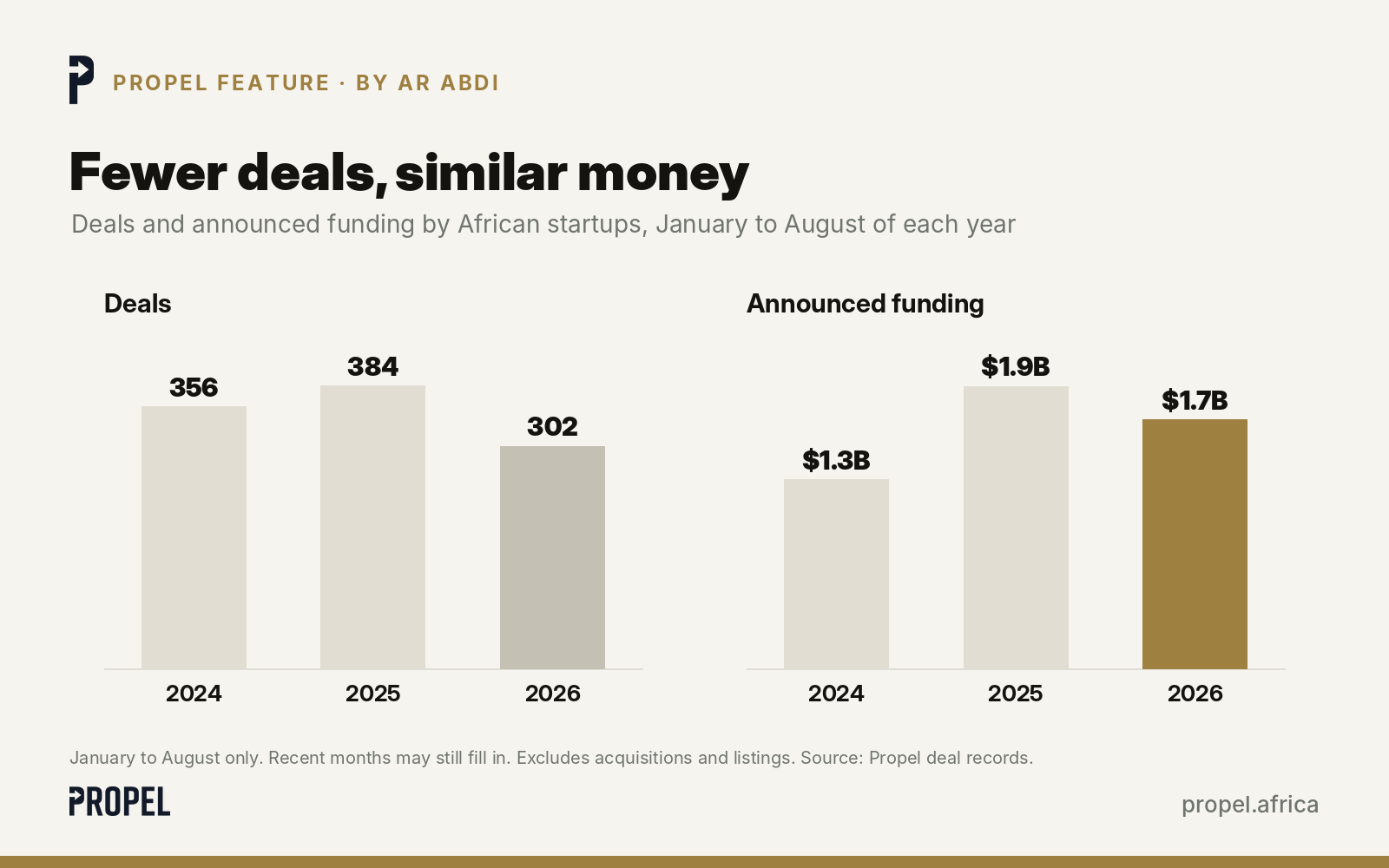
The short answer is that African startups announced about $1.7 billion across 302 deals between January and August, according to Propel Africa's records. That is fewer deals than in the same months of 2025 (384) and a little less money ($1.9 billion), but the headline numbers hide a more interesting story.
A quick word on the data before we start. These figures count announced funding rounds, grants and debt deals, and leave out acquisitions and listings. Records for recent months tend to fill in as late announcements arrive, so the gap with 2025 may narrow. Treat the comparisons as direction rather than final scores.
The year of things that move
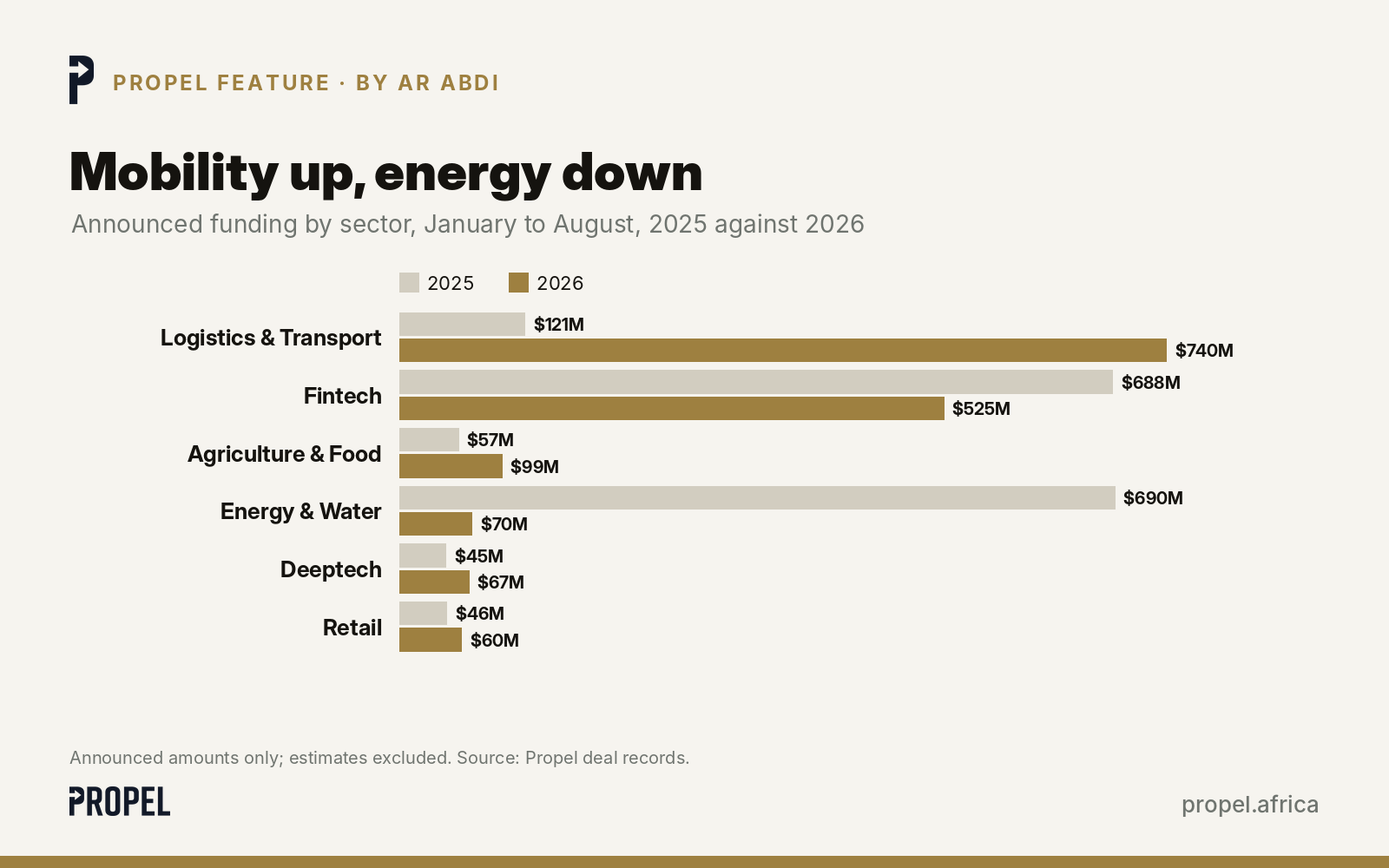
If one theme defines 2026 so far, it is mobility. Logistics and transport companies announced about $740 million between January and August, against about $120 million in the same months of 2025.
Two companies did most of the lifting. Moove, founded in Nigeria as a vehicle financier for ride-hailing drivers and now also building fleet infrastructure for autonomous vehicles, raised a $250 million Series C in August at a $2.1 billion valuation, led by Mubadala. Spiro, the electric motorbike and battery-swapping company, closed a $270 million equity round in June, backed by Impact Fund Denmark, Equitane and NewTrails Capital, on top of a $50 million debt facility from Afreximbank, Nithio and Africa Go Green Fund in February.
Smaller players are building in the same direction. Zeno in Kenya raised a $25 million Series A in March to build electric motorcycles, and GoCab in Côte d'Ivoire combined seed equity with debt to finance vehicles for drivers.
Energy went the other way. Energy and water companies announced about $70 million in the first eight months of 2026, against about $690 million in the same months of 2025, when large debt facilities for d.light and Sun King lifted the total.
What I find striking is how physical the mobility money is. These are companies buying motorbikes, batteries and cars, and they are raising the kind of capital that only works when there are real assets underneath.
Fintech: still the most deals, less of the money
Fintech remains the busiest sector by a distance, with 81 deals so far this year. But the money tells a different story: about $525 million, down from about $690 million in the same months of 2025.
Much of it now looks like infrastructure and credit rather than new consumer apps. Yellow Card raised $40 million in August from investors including SC Ventures and Sony Innovation Fund to grow its stablecoin-based dollar accounts. And a growing share of fintech money is borrowed: ValU in Egypt secured $63.6 million from National Bank of Egypt in January, and Nala a credit facility of up to $50 million in May.
Debt keeps its seat at the table
Across all sectors, debt made up about a third of the money announced this year. That is now normal rather than unusual. Companies with assets or loan books, from vehicle financiers to solar and agriculture businesses, are borrowing to grow rather than selling more of the company.
I will come back to this in a later feature, because I think it is one of the most important shifts in African venture, and one that founders still underestimate.
Nigeria leads, Kenya quieter
Nigeria led the continent with 77 deals and about $510 million announced, though Moove's $250 million accounts for about half of that money. Egypt followed on money with about $315 million, helped by rounds such as Breadfast's $50 million in February, backed by Mubadala, SBI Investment and Olayan.
Kenya is the surprise. It recorded 44 deals in the first eight months, against 64 in the same period of 2025 and 87 in 2024. Kenyan companies still raised meaningful sums, but the volume of deals has clearly slowed. South Africa recorded 31 deals, down from 51 in the same months of 2025.
What the typical round looks like
For founders, the most useful numbers are often the typical ones rather than the headlines. In 2026 so far, the median seed round with an announced amount was about $2.4 million and the median Series A about $10.4 million. Those are close to the levels I set out in the Propel Guide, which suggests round sizes have settled rather than kept climbing.
There were 38 rounds of $10 million or more, and the five biggest deals made up about 40% of all the money, slightly more than in 2025. A handful of very large rounds still shape the totals.
Two other numbers caught my eye. Climate-related companies accounted for 89 deals and close to $590 million, so climate is now woven through mobility, energy and agriculture rather than sitting in its own corner. And 84 of the 302 deals went to companies with at least one woman co-founder, about 28%: up on 2025, below 2023 and 2024, and still far from where it should be.
What I take from it
Three things stand out for me.
First, African venture is becoming more practical. The biggest cheques of the year went to companies that move people and goods, and to lenders who can show what they will do with every dollar.
Second, the money is following assets. Founders who can point to motorbikes, batteries, inventory or a loan book have more options than ever, including debt.
Third, fewer deals means more competition. Rounds at seed and Series A are holding their size, but the number of deals is down by about a fifth on last year, and I suspect founders raising between $1 million and $10 million are feeling it most.
I will keep tracking this through the rest of the year. If you want to dig into any of the companies above, you can find them on Propel Africa, with their funding history and the investors behind them.
How we measured
Figures cover deals recorded by Propel Africa between January and August of each year, excluding acquisitions, listings and secondary sales. Money counts only announced amounts; estimated amounts are excluded. Spiro's June raise is counted as one $270 million round reported in two parts. Records for recent months may still change as late announcements are added.